Skip to content

Uplevel vs. LinearB

LinearB helps engineering teams improve PR flow and automate the rules around reviews. Uplevel works on the broader organizational issues that keep slowing delivery, including unclear ownership and the way work moves between teams.

featuredimage-competitorpage-linearB

TL;DR

LinearB and Uplevel both give engineering leaders visibility into delivery performance, but they’re built for different kinds of problems.

LinearB is centered on the pull request workflow. It measures delivery performance and uses gitStream to automate routing, reviews, and policy inside that workflow.

Uplevel measures many of the same outcomes, then connects them to developer feedback, interviews, and the way teams actually work. Practitioners use that context to help leaders and teams deal with the issues behind the numbers.

Which is a better fit?

LinearB is a strong fit when you want to improve PR flow and automate review policy.

Uplevel is built for delivery problems that don’t stay inside one workflow. AI may be increasing code volume faster than review and release can absorb. A reorg may have left ownership muddy. Those problems usually need more than another routing rule.

Uplevel vs. LinearB at a glance

  LinearB Uplevel-Logo-light-version
Core approach Delivery metrics plus gitStream workflow automation Measures delivery outcomes and the operating conditions affecting them
Outcome metrics DORA metrics, PR cycle time, investment allocation Lead time, PR cycle time, new value vs. rework and maintenance, developer-reported friction and productivity
Qualitative data Primarily system data Surveys + structured interviews with engineers and leaders
AI measurement Compares AI-assisted PRs to baselines and estimates AI cost Connects AI usage to delivery outcomes and identifies where the surrounding system is holding back value
What happens after the finding Dashboard insights + gitStream automation Practitioners work directly with leaders and teams on what to change
Where it looks The PR workflow The organization around the workflow
Best fit Improving and automating PR flow Diagnosing recurring delivery constraints that span teams
 

What LinearB does well

gitStream lets engineering teams put review policy into code. It can route PRs, assign reviewers, add labels, and automatically approve low-risk changes based on rules the team defines.

That’s genuinely useful when the friction is inside the PR workflow. If too much work is landing with the wrong reviewers or low-risk changes are waiting unnecessarily, automation can take a lot of manual handling out of the process.

PR Workflow Automation Visibility (1)
From Causes to Sustainable Change
 

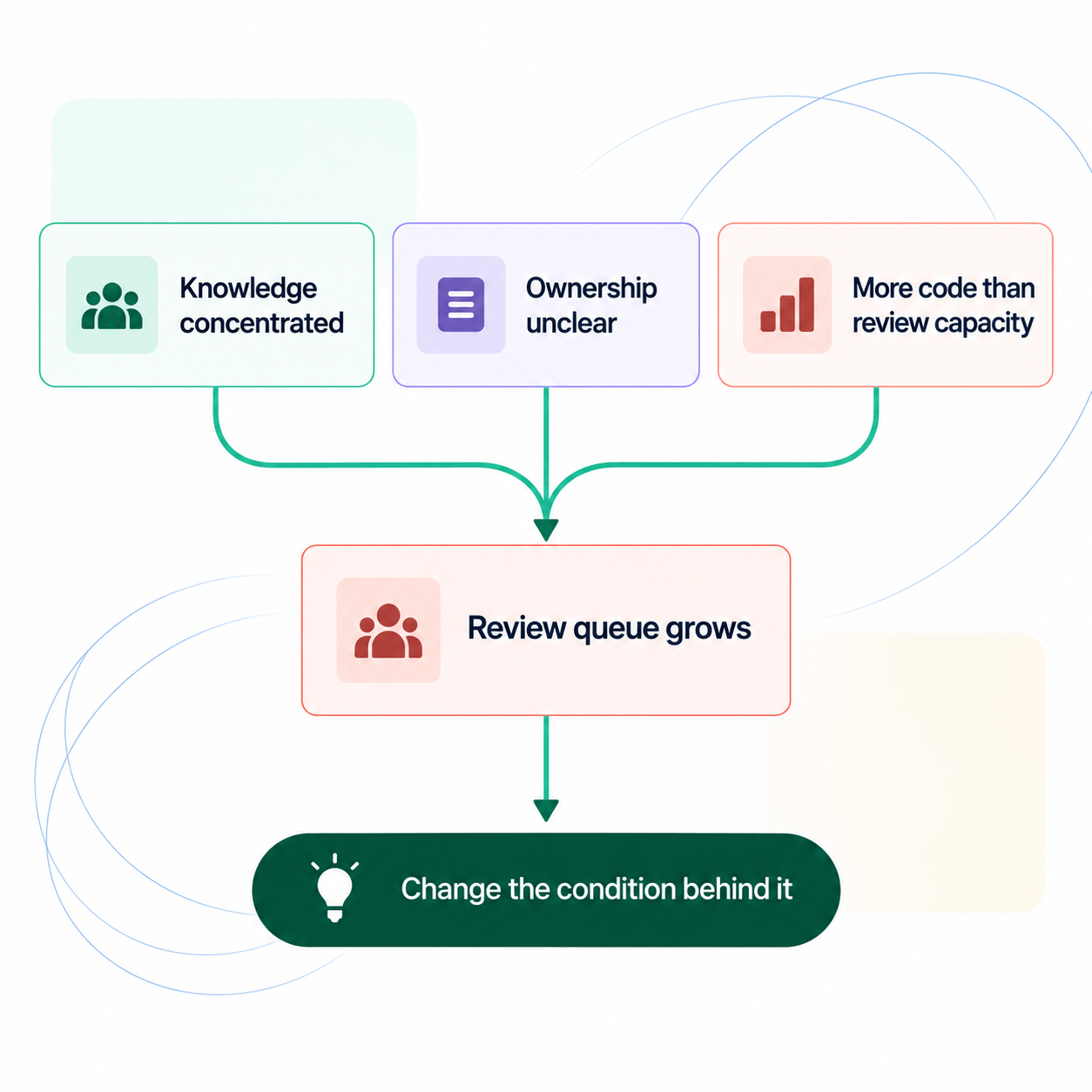
Why the queue keeps coming back

A slow review queue is easy to see in delivery data, and gitStream may be able to move work through it faster.

Sometimes the queue is a symptom of something outside the PR workflow. A reorg may have concentrated service knowledge with a few people. AI may have increased code volume without changing review capacity. In those cases, better routing helps, but it doesn’t remove the constraint.

Uplevel combines system data with surveys and interviews to understand what’s actually driving the slowdown. Practitioners then work with the teams involved on the issue itself.

What comes after automation


LinearB block

LinearB treats delivery friction as a workflow problem.

Its core thesis is that the right rules can clear any bottleneck by encoding how PRs get routed and reviewed. But a rule can only be written for a constraint someone already understands, and all it can do is route around it. There are many reasons why work stalls, and only some of them can be fixed with automation.

Uplevel block

Uplevel looks at software engineering as a complex system.

Software can surface a queue, and automation can help at times. Truly fixing the cause takes people who understand how the organization works, ask the right questions, and help teams change how they operate. Uplevel practitioners work with leaders and teams to find bottlenecks and fix them for good.

How Uplevel works differently

Our system combines tooling and behavioral metrics, deeper qualitative analysis, and experts who help teams build the organizational muscle to keep getting better.

friction

We measure what’s behind the metric

Uplevel dives deeper into the operating behaviors that may explain delivery metrics and developer sentiment. That lets us test whether reported friction is actually showing up in delivery — and which behaviors are worth changing.

interview

Interviews expose the weird stuff

We use developer interviews to understand how bottlenecks got baked into the way the organization works. That gives us a much better read on what can actually change without creating a new problem somewhere else.

capability-over-time (1)

Practitioners build your team's capability

Uplevel practitioners help teams work through the problem in front of them while building the skills to do the same work themselves next time. Your org gets better at finding constraints and improving without outside help.

StackUp Hero (1)

Find the leak in your AI investment

StackUp is a free 45-minute session that pinpoints which of six AI cost leaks is hitting you hardest. It's also the fastest way to see how Uplevel works.

Frequently asked questions

What is working with Uplevel like, and how long until we see value?

Uplevel is designed to show value very quickly and avoid some of the blockers that make traditional SaaS implementations take forever.

StackUp gives you a first read in 45 minutes. From there, GearUp is a 45-day Proof of Impact, about 3 hours of your team's time, that pairs sanitized data exports with DevEx Discovery™ interviews, surveys, and expert interpretation to diagnose root causes and build a prioritized roadmap — no six-month infosec review required.

Full platform access comes with Uplevel Enterprise, along with practitioner support that's designed to taper as your team builds the capability to identify problems and act on them on its own.

If gitStream already automates our reviews, what’s left to fix?

gitStream is useful for automating review rules. If the same bottleneck keeps returning after the routing is tuned, the issue may sit somewhere else in the organization.

Uplevel looks at developer feedback, interviews, and delivery data together to figure out what’s causing the slowdown, then works with the teams involved on the change.

Can I run Uplevel and LinearB together?

Yes. LinearB can automate policy inside the PR workflow while Uplevel works on the broader conditions affecting delivery.

GearUp is the easiest way to see what Uplevel adds: a 45-day Proof of Impact using your own data, with a prioritized roadmap for change.

What does Uplevel find that delivery metrics miss?

Uplevel often finds the organizational reasons a delivery problem keeps recurring: ownership that became unclear after a reorg, an approval that outlived the problem it was created to solve, or a team that has quietly built a workaround around the official process.

Interviews with engineers and leaders are especially useful here because they explain how the organization ended up working that way in the first place.