Equinix, Inc. (Nasdaq: EQIX) is the world's most trusted AI exchange, shortening the path to boundless connectivity. Its digital infrastructure, data center footprint and interconnected ecosystems empower innovations that enhance our work, life and planet.
SVP of Engineering AJ Coon leads Engineering Excellence (E3), part of the company’s Digital and Innovation Organization. His teams are changing how software gets built and shipped, using AI throughout the development process. Roles are shifting, and teams are building and deploying agents at scale.

Rebuilding the SDLC while running on it
E3 began as Coon’s passion project several years ago and, with the company’s rapid embrace of AI transformation, almost immediately became his full-time scope. With people across product, software development, site reliability, support and hardware roles, the organization is structured into verticals that drive delivery for Equinix’s developer experience portfolio. “The developer platform used to be where code got written. Now it’s where intent gets written. Our engineers specify what the software should do, and the platform does the building,” Coon explains.
The Chief AI Officer’s organization builds the company’s agentic platform, while Coon’s teams build the development platform underneath it. More than 20 agents are already at work across the product development lifecycle, including intake and evaluation of new ideas, sizing, risk analysis, coding, testing, infrastructure management, reliability, and more. Under Chief Digital and Innovation Officer Harmeen Mehta, the organization is now running its own AI-first transformation in parallel to driving similar initiatives for the rest of the business.
Rolling out AI assistant tools was the first phase. Now Coon is focused on fluency and impact. Usage is broad, but the people delivering the most value with the tools remain in a narrow band at the top of the curve. Helping the rest of the org transform is next.
Measuring the human side of transformation
There is no established playbook for building agentic systems. The DORA and SPACE frameworks describe process, but Coon wanted a measure of the social side of the transformation because people were absorbing much of the change. He needed a baseline for how his teams worked—and a way to keep adapting as the transformation work evolved.
The priority was quantifying and managing interruptions: how much time developers were losing to everything that pulled them away from their work. Time spent delivering value would define success.

Coon engaged Uplevel, an engineering intelligence company that surfaces the human context behind engineering performance and guides subsequent changes. Data on how work moves and where it gets interrupted is the starting point. DevEx Discovery™ surveys and team interviews surface root causes behind engineering bottlenecks, and an Uplevel transformation team works through the resulting changes alongside teams and leaders.
Defining what value means
Coon has been sharpening his definition of success for years. Value delivery is the metric he optimizes for, but activity is what too often gets mistaken for it.
His organization faces a more complicated measurement problem than most. Digital and Innovation builds for internal customers, so the connection to P&L is indirect. His teams are working with product partners to define what a delivered outcome looks like, so they can measure what comes after shipping and the yield on human and agentic work.
Baseline before acceleration
Equinix scoped the work across a cross-section of the Digital and Innovation Organization, from first-party development to off-the-shelf systems supporting corporate functions. The hypothesis was that small inefficiencies that had been manageable for people could become load bearing as agents took on more of the work.
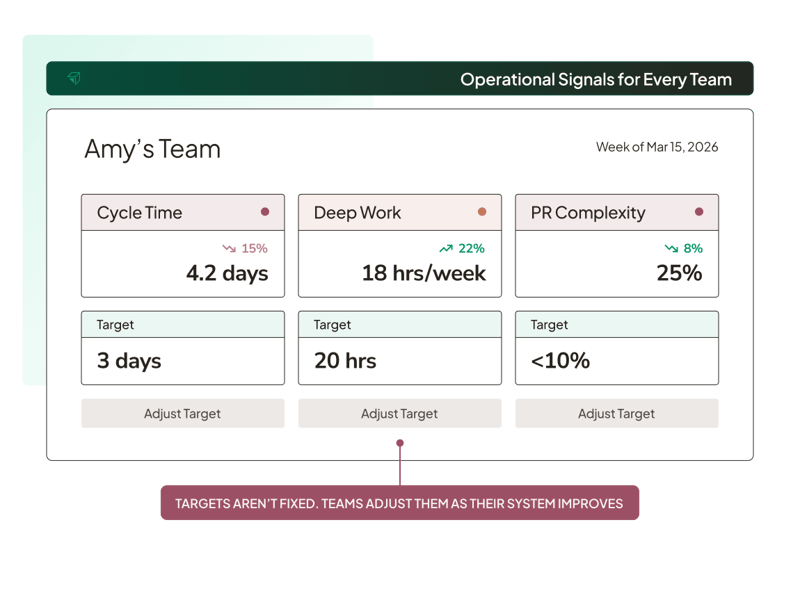
The first thing Uplevel surfaced was variation in how teams collaborated. Many repositories were widely shared but had no clear owner, single services spanned multiple teams, and cross-team dependencies meant that delays were often structural. Those dependencies became obvious places to start. Variation also appeared in delivery metrics: breaking cycle time down from commit to deploy revealed some teams releasing weekly or monthly without automated pipelines, while others shipped continuously.
Coon’s team was tackling the same question one layer down, building an as-is model of how change reaches production: where artifact repositories were, where test infrastructure sat, and what ran between environments. The inventory exposed a number of repositories with no pipeline definition. It also exposed legacy platforms where deployments were still handled by hand.
From insight to action
Teams responded well to the insights. Putting them into practice was more difficult, as Coon expected: good data doesn’t, by itself, change how an organization works.
The Uplevel transformation team worked with teams to turn those findings into changes. E3 already had built relationships and trust with the teams it advises. Uplevel workshops brought teams together to discuss the root causes and propose the fixes themselves, so what went back to Coon and his managers was something the teams had authored and already bought in on.
Another initiative was last-mile delivery for the organization’s golden pipeline, a baseline set of continuous integration and deployment capabilities available to every team. Uplevel’s analysis identified opportunities to optimize enablement and provisioning to make the pipeline the default path to production, and the teams are actively working through that list.
Finally, Equinix is building infrastructure to keep the transformation moving. A weekly operations review starts with customer impact before root cause for any problem: how many users are impacted, for how long, and what it costs in revenue or productivity.
These changes depend on more than metric visibility. Coon credits the Uplevel partnership with helping Equinix drive change at all levels:
What the next year requires
Coon’s definition of success for software engineers is changing as well: “They are high-judgment, high-decision, high-context strategic thinkers that are transitioning to be more like tech leads and architects in the way that they approach their role.”
Engineers make high-judgment calls in organizations that encourage them, so Equinix is working to push more decisions down to the teams — a shift Uplevel’s executive readout helped bring into focus —alongside rewriting career ladders and job descriptions so people have a clear path to growth and promotion. Training is just as important. Every engineer at Equinix is learning alongside an industry that is still figuring it out. Coon’s job is understanding that learning curve and investing in it, which is also why Equinix is hiring systems thinkers as mentors.
Coon’s advice for leaders undertaking a similar rebuild: “Start early and show your team. Make sure you have a chance to socialize the idea that you need to understand the full set of investments that you’re making.” Then staff for the change itself: your own support structure inside the team, working alongside your partner and the change champions in delivery teams, in place before the work starts.
For all the changes agentic transformation has required, Coon points first to its social impact: