From Fast to Forward
The AI rollout is over.
Here’s how engineering orgs catch up.
When factories first adopted electric motors in the late 1800s, most simply dropped them in to replace their steam engines. Productivity barely moved. It wasn’t until engineers redesigned the factory floor around what electricity made possible that the gains arrived. The technology had been available for decades before it created meaningful impact.
Engineering organizations are somewhere around year three of that story. But with incredible pressure to ship faster, you aren't getting a generation to wait for the return.
The board wants receipts
In 2025, the question from upstairs was whether you were 10x-ing with Copilot yet. In 2026 it’s blunter: we approved the budget, we gave you the year, what came of it?
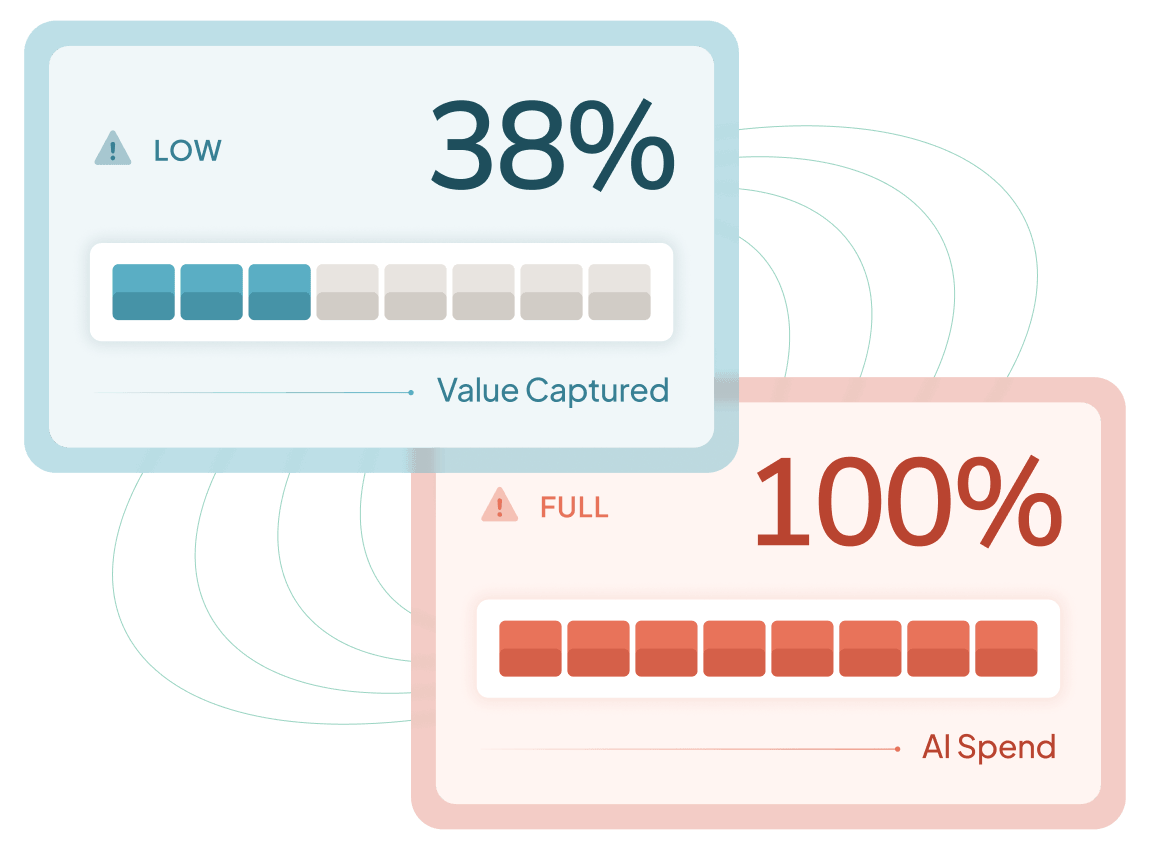
The honest answer in a lot of organizations is some local improvement and a spend line that climbs every quarter. Vendor consoles can break that cost down by model, workspace, API key, and token type. But none of that explains whether the organization is getting value back.

of engineering leaders say AI has created significant value in their organization
can point to a metric they track to prove it
Source: Uplevel Research, September 2026
Engineering leaders are being asked to explain the economics of a system that was never redesigned around AI.
They are responsible for shepherding in a new era of productivity while running an organization built for a different era of software development.
The pressure is to accelerate. But acceleration isn't a switch you flip.
The joke circulating in tech circles right now is that AI development is “one engineer with two dozen Claudes.”
It captures a real executive fantasy. The reality, as leaders are finding, is cutting headcount and then discovering that the AI bill keeps climbing without much to show for it. Dropping AI into an existing system just moves the bottleneck. Roles, ownership, workflows, architecture, org design — all of it has to evolve together, or speed compounds the dysfunction.
You can’t swap out developers for AI without reckoning with what development actually is: a system of interdependent decisions, constraints, handoffs, and context that no tool or agent, however capable, can navigate alone. Any serious approach to AI transformation has to design for those things — and do it in an environment that keeps moving.
AI changes faster than organizations can adopt it
Previous technology shifts were disruptive, but they were bounded. Agile gave teams a methodology. Cloud gave infrastructure a new shape. DevOps gave delivery a philosophy. In each case, a reasonably clear destination existed, and organizations could move toward it.
AI doesn’t work that way.
The rollout that made sense eighteen months ago is already stale. The thing that replaces it may be stale by the time procurement clears it.
Organizations need the ability to absorb that change without rebuilding themselves from scratch every time the tools move. Every organization is different, too. What worked for the companies giving conference keynotes was built for their specific context, their people, and their moment. Copying the output without doing the underlying work produces nothing at best. At worst, it accelerates an organization in a direction that was never right to begin with.
Your AI spend has an explanation.

StackUp is a free 45-minute session with an Uplevel expert. You’ll leave with a read on which anti-pattern is most likely costing you and how you compare with similar organizations. We’ll also identify one change to make first.
Insight alone has never moved an organization
Most organizations sense they need help, but the most common options are limited.
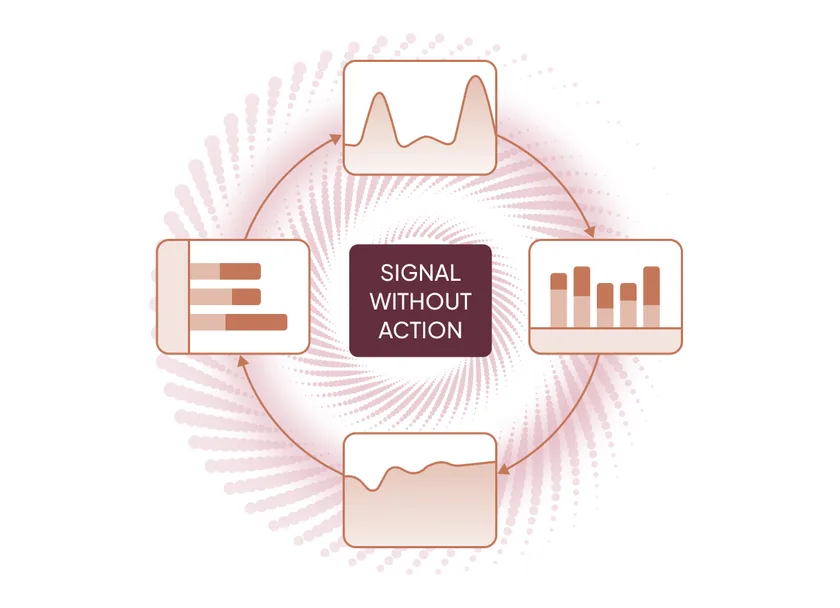
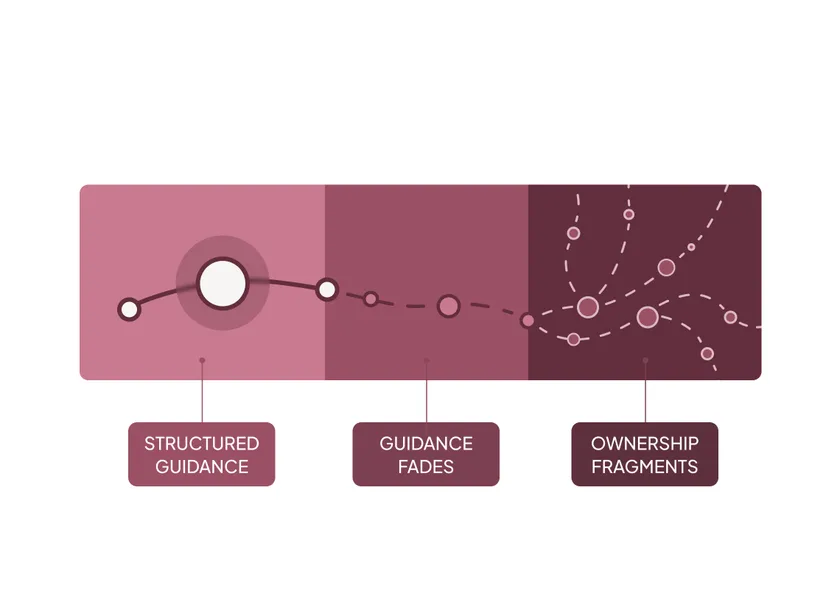
Both approaches treat AI transformation as a problem with a finish line. There isn’t one.
What needs to be true instead
The organizations pulling ahead share a few key characteristics, all of which point to building capability at a systemic level. These are not boxes to check — they're conditions that have to be built, and they look different in every organization.
Their technical foundations are solid enough to handle what AI generates. AI-assisted development has correlated with a 41% increase in bug rates in Uplevel's own research — code moving fast into a fragile pipeline doesn't ship faster, it accumulates.

They treat context as infrastructure. Engineers aren’t reconstructing architecture, conventions, and service boundaries from scratch on every task. That shared understanding is maintained collectively, kept current, and accessible to both humans and the agents working alongside them.

Teams are structured to move independently. Org design and system architecture are aligned — teams that can’t deploy without waiting on other groups become the bottleneck regardless of what tools they’re using.

Ownership and governance hold, even when AI wrote the code. Engineers feel accountable for outcomes, not only the lines they personally typed. That’s a cultural condition that has to be built deliberately, and it’s the first thing that breaks under pressure if it wasn’t established before AI arrived.
Senior engineers are doing different work. More time on system design, problem framing, and deciding what to build. Orgs that don’t design for this shift end up with a faster factory, not a more capable one.
None of this happens by merely adopting a tool.
It requires reorganizing around what the tools make possible. Organizations with fully integrated AI are nearly four times more likely to report revenue growth than those still running pilots — 58% versus 15%.
The ones pulling ahead built the foundation first, and they’re ending up with something harder to replicate than any tool advantage: engineers doing their best work, a system legible enough to change deliberately, and the organizational confidence to meet the next disruption on their own terms.
Source: Grant Thornton
How AI-first engineering transformation actually happens
Most frameworks for engineering improvement focus on what to change. The harder question is how change actually takes hold in organizations full of people with competing priorities, institutional habits, and reasonable skepticism about the next initiative.
Here's what that looks like in practice:

What’s happening and why it’s hard to change are two separate problems.
Engineering organizations are human systems. Technical data tells you what’s happening. The social layer — the politics, habits, and misaligned incentives — tells you why change is hard even when everyone agrees it’s necessary. Most solutions address one. Both layers have to move together.

The right intervention depends entirely on what’s actually broken.
The right answer depends entirely on what’s underneath the surface problem, and that’s rarely obvious until you look. Deeply. Most organizations find a different problem than the one they started with. Deploying any solution (dashboard, AI tool, or consultant) before completing that work accelerates in the wrong direction.
The goal is to build the muscle for change — capability that compounds.
That means building the capacity to identify problems, respond to them, and adapt as conditions shift — without outside help. Few consulting engagements and even fewer vendor contracts start with this as the objective. Ours does, and it shapes everything about how we work.
Find the leak in your AI value
AI spend usually has an organizational explanation.
StackUp is a free 45-minute session with an Uplevel expert. We’ll look for the patterns driving cost or friction in your organization, compare them with what we see in similar engineering teams, and identify one place to start.