Would You Recognize AI ROI If You Saw It?

New research from 428 engineering leaders

Get the full report:

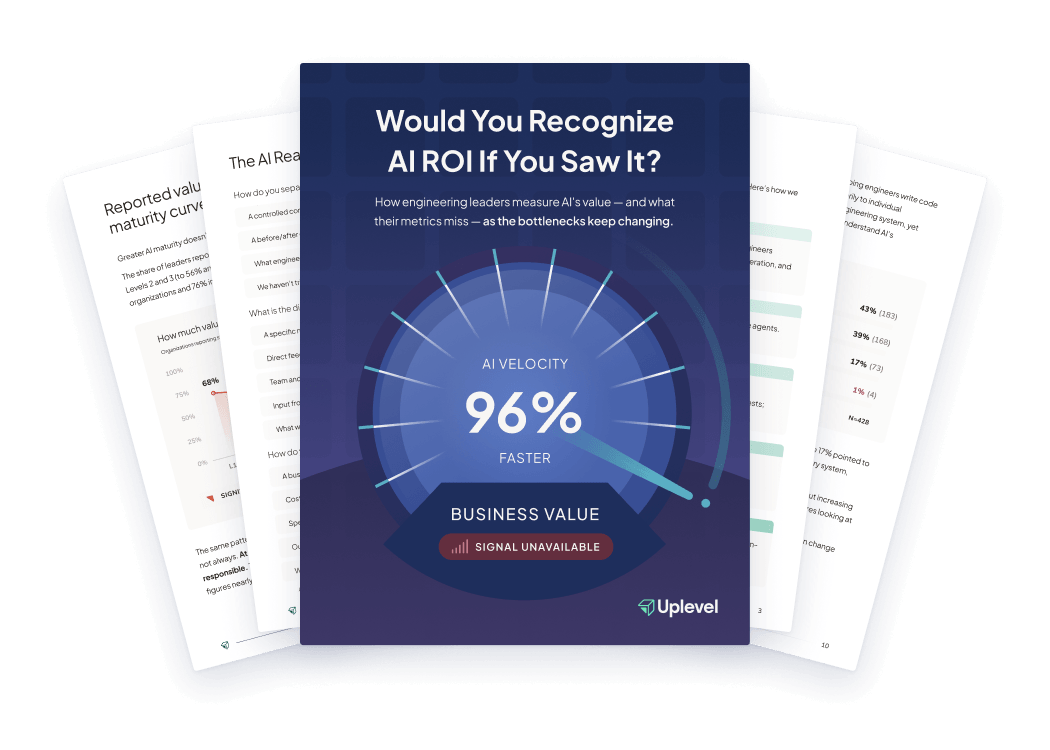
Would You Recognize AI ROI If You Saw It? report cover

Uplevel's fall 2026 survey shows how engineering organizations are measuring AI's impact, where new bottlenecks are emerging, and what their metrics may be missing.

Engineering leaders are under pressure to show returns on AI investments. And most are confident those investments are paying off.

96% of respondents said they were confident AI was responsible for improvements they'd observed. Yet only 40% reported using controlled comparisons to isolate AI's contribution from other changes.

That leaves a difficult question for leaders deciding what to invest in next: how much do you really know about what's driving the results?

What engineering leaders told us

74%

have extended their existing ROI measurement approaches to AI.

29%

identify increased time reviewing AI-generated code as their biggest new source of friction.

18%

use a specific tracked metric to identify their biggest obstacle to getting more value from AI.

The findings suggest that while AI is making parts of engineering faster, leaders are still working out how to measure its contribution to overall performance.

Q4 2026 Engineering Leadership Survey · 428 engineering and technology leaders surveyed August 31–September 3, 2026.

Inside the report

Find out how engineering organizations are evaluating AI ROI, including:

dark-checkmark
How leaders distinguish AI's contribution from other changes in engineering performance.
dark-checkmark
Why faster code generation is putting pressure on review and other parts of the delivery process.
dark-checkmark
How the biggest obstacles to AI value change as organizations become more mature.
dark-checkmark
Where existing engineering metrics help, and where leaders need additional evidence to make investment decisions.

The report also includes a three-question self-assessment to compare your measurement practices with those of the leaders we surveyed.

Read the research and see how your approach compares.