TL;DR
Jellyfish and Uplevel both help engineering organizations understand where time and investment are going, but they’re built around different approaches to improvement.
Jellyfish maps engineering effort and AI spend to business categories through a self-serve platform built for engineering and finance leaders. Uplevel measures many of the same outcomes, then looks further upstream at the team behaviors and operating patterns producing them. That means combining system data with developer feedback and structured interviews, then putting practitioners into the work with leaders and teams.
Jellyfish is a strong fit for organizations that need an ongoing view of how engineering time maps to business priorities — especially where finance and product need the same picture engineering does.
Uplevel is designed for organizations that need to understand what’s driving performance and make a change around it. That could be an AI investment that isn’t showing up in delivery performance, a reorg that has created new friction, or a recurring delivery problem that has survived several rounds of reporting without getting much better.
Uplevel vs. Jellyfish at a glance
| Jellyfish | ||

|---|---|---|
| Core approach | Maps engineering effort and AI spend to business categories, plus modular metrics dashboards | Measures outcomes, finds the behaviors and workflow patterns behind them, and helps teams change them |
| Outcome metrics | Cycle time, PR throughput, DORA metrics, investment allocation (feature vs. bug vs. maintenance vs. unplanned work) | Lead time, PR cycle time and throughput, DORA metrics, investment allocation (new value vs. rework and maintenance), developer-reported friction and productivity |
| Qualitative data | Optional DevEx survey module | Surveys and structured interviews with engineers and leaders |
| AI measurement | Tracks AI token cost and adoption tied to allocation categories | Connects AI usage to delivery outcomes, finds where value is getting lost, and helps teams improve the underlying workflow |
| What happens after the finding | Dashboards, an AI assistant for reports and Q&A | Uplevel practitioners work directly with leaders and teams on interpreting their data and deciding what to change |
| Primary audience | Engineering leadership, product, and finance | Engineering leaders and the teams doing the work |
| Best fit | Visibility into where engineering investment and AI spend are going | Understanding what’s driving the numbers and doing something about it |
What Jellyfish does well
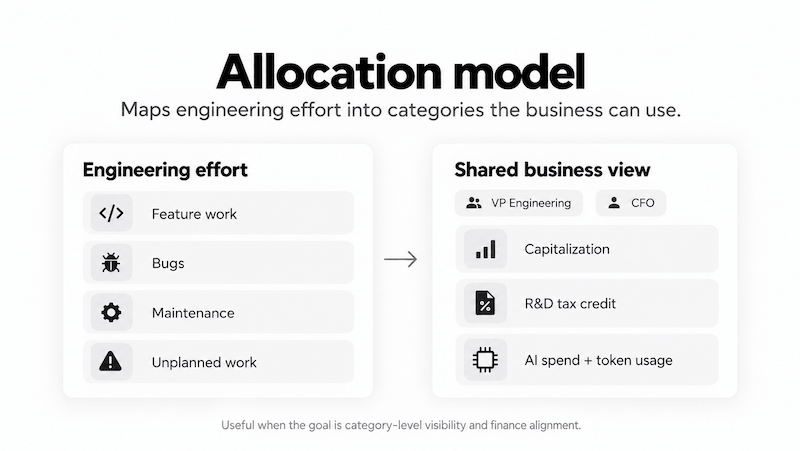
Jellyfish's Allocation model is the core of its platform. Jellyfish automates audit-ready capitalization and R&D tax credit reporting. Engineering effort gets mapped to a business category — feature work, bugs, maintenance, unplanned work — so a VP of Engineering and a CFO can look at the same number and mean the same thing by it. That category-level view now extends to AI spend and token usage, which is where a growing share of Jellyfish's roadmap is headed.
Uplevel surfaces the signal and the source
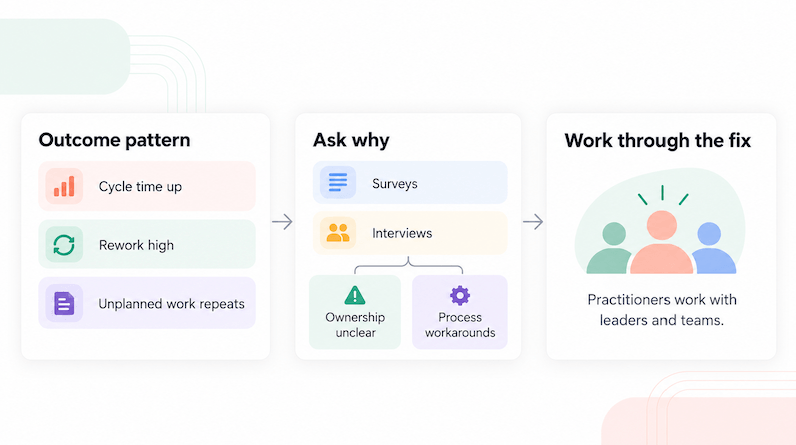
Where Jellyfish sorts effort into categories, Uplevel asks what's producing the pattern of effort in the first place. Our software tracks the same throughput and allocation outcomes, but a category breakdown only tells you where time went, not why a team keeps landing in “unplanned work” quarter after quarter.
We get at the cause by asking. Surveys and structured interviews with engineers and leaders show where ownership is unclear and the reasons people work around a process. Uplevel practitioners then work through the fix with those leaders and teams. It's the hardest part of improving, which is why practitioners do it with you.
What comes after allocation
|
Jellyfish's newest investment extends allocation into AI: mapping token cost to the same business categories as engineering effort. |
Engineering leaders are right to watch AI spend closely, but cost alone doesn't tell you why one team's token costs are triple another's. |
How Uplevel works differently
Our system combines tooling and behavioral metrics, deeper qualitative analysis, and experts who help teams build the organizational muscle to keep getting better.
We measure what’s behind the metric
Uplevel dives deeper into the operating behaviors that may explain delivery metrics and developer sentiment. That lets us test whether reported friction is actually showing up in delivery — and which behaviors are worth changing.
Interviews expose the weird stuff
We use developer interviews to understand how bottlenecks got baked into the way the organization works. That gives us a much better read on what can actually change without creating a new problem somewhere else.
Practitioners build your team's capability
Uplevel practitioners help teams work through the problem in front of them while building the skills to do the same work themselves next time. Your org gets better at finding constraints and improving without outside help.
“Jellyfish is just more charts and more data... We've got these numbers, but we're still like, 'and so what? What are we supposed to do with that?'... We need people that have not just the tool, but the knowledge base, the thought leadership on how to think about this stuff... Bring that industry experience to us."
Engineering leader
Frequently asked questions
What is working with Uplevel like, and how long until we see value?
Uplevel is designed to show value very quickly and avoid some of the blockers that make traditional SaaS implementations take forever.
StackUp gives you a first read in 45 minutes. From there, GearUp is a 45-day Proof of Impact, about 3 hours of your team's time, that pairs sanitized data exports with DevEx Discovery™ interviews, surveys, and expert interpretation to diagnose root causes and build a prioritized roadmap — no six-month infosec review required.
Full platform access comes with Uplevel Enterprise, along with practitioner support that's designed to taper as your team builds the capability to identify problems and act on them on its own.
Does Uplevel replace our DevFinOps reporting?
No. Uplevel doesn't handle software capitalization or R&D tax credit reporting — that's a distinct finance workflow. Some organizations run Jellyfish for that reporting layer and bring in Uplevel for root-cause diagnosis and practitioner-led change.
Can I run Uplevel and Jellyfish together?
If you're already running Jellyfish, GearUp is the easiest way to see the two side by side — a 45-day Proof of Impact, using your own data, that shows exactly what Uplevel does and how we're fundamentally different. You'll get a deep analysis of your 2-3 most important opportunities for improvement along with a prioritized roadmap for change.
How is Uplevel's approach different from Jellyfish's Allocation model?
Allocation tells you where engineering time and AI spend are going, mapped to business categories. Uplevel tracks similar ground but also looks at the behaviors driving those numbers, and pairs the data with a practitioner who works directly with the organization on what to change.