

Most engineering leaders have a version of this story: the organization brings in an external consulting firm to help with some engineering transformation initiative. A roadmap gets delivered. Action items get assigned. Six months later, the teams are working the way they were before — plus or minus a few metrics on a dashboard nobody opens.
This pattern recurs because the same approaches keep getting applied to a problem they weren't designed to solve. There are a few criteria that distinguish engagements that produce lasting change from those that don't. Here’s what to look for before you commit to one.
What does [successful] engineering transformation consulting involve?
Engineering transformation consulting addresses the systems that determine how an organization adapts and delivers over time: processes, measurement infrastructure, and team capabilities. With AI, the entire system often needs to be examined as teams adopt agents — for most teams, the SDLC of the past two to three decades looks vastly different from one that AI can accelerate.
Engineering transformation consulting is designed to help organizations capitalize on the promises of the agentic SDLC. It’s different from management consulting, because the two solve different problems. Management consulting firms have a model that is top-down by design. They enter, interview leaders, analyze, and produce high-level recommendations at the executive level. For problems like organizational restructuring or cost structure, that model produces real value.
But C-suite recommendations don't reach the ground-truth technical signals that explain why teams work the way they do.
Classic interventions with clear short-term ROI — headcount reductions, cost consolidation — differ from the investments that build engineering capability. And the engagement model doesn't include staying around to validate whether recommendations take hold.
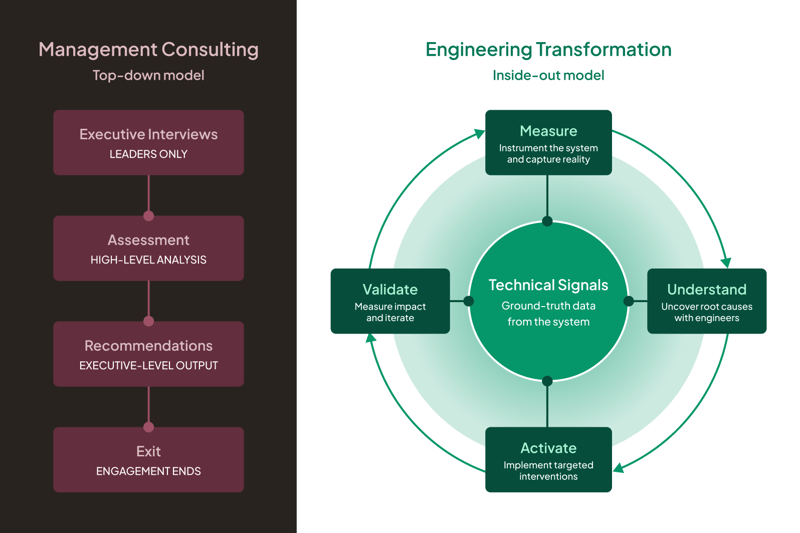
What engineering transformation consulting actually requires is a model that gets close to the technical reality, builds measurement infrastructure alongside recommendations, and stays accountable to what the data shows.
Why do most transformation initiatives fail to produce lasting change?
Two failure modes account for most of what goes wrong, and they tend to repeat.
Recommendations without a measurement foundation
Traditional consulting engagements produce roadmaps built from point-in-time observations. The analysis can be sound at the moment of delivery. But without capability-building work or continuous measurement to validate progress, those roadmaps become static artifacts — the org has no way to track whether anything actually changed, and the roadmap has no mechanism for adapting when conditions shift.
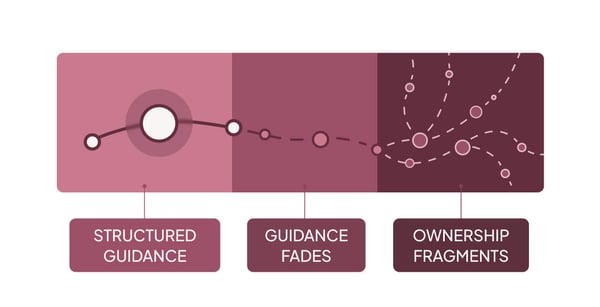
There's a second problem that compounds the first: fragmented ownership. When an external team leads the diagnostic and produces the recommendations in a vacuum, accountability for execution lands in an ambiguous place. The teams responsible for carrying out the work weren't part of building the analysis. The consultants who built it are gone. No one holds the full picture, and no one holds the obligation to track whether the picture changes. The roadmap exists; the ownership of the roadmap does not.
Measurement without a change methodology
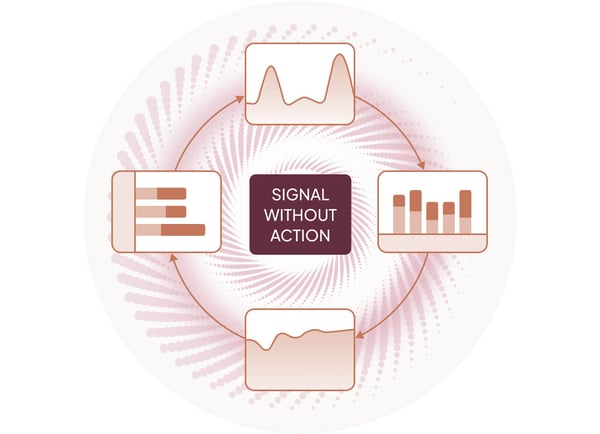
Engineering intelligence platforms and dashboards create visibility. While visibility is a prerequisite for decision making, it has no mechanism alone for producing behavioral change. Teams can see data they don't know how to act on, and after enough cycles of that experience, they stop looking at it. Dashboard fatigue is a design problem — a consequence of building infrastructure that surfaces signal without building the capacity to respond to it.
Gergely Orosz and Kent Beck document what this looks like in practice. After Uber introduced an engineering metrics dashboard tracking output, lines of code written didn't change meaningfully — but CI system utilization spiked as developers started creating more, smaller diffs to improve their scores. Costs went up as the metric moved. The pattern is reliable: measurement without a methodology for turning data into behavior change produces games, not progress.
What does an effective approach require?
Data without qualitative context produces false confidence, and qualitative context without measurement produces untestable hypotheses. Findings handed down to teams without their direct involvement tend to sit on a shelf. In order for engineering transformation consultants to actually succeed, they need to bring three elements together:
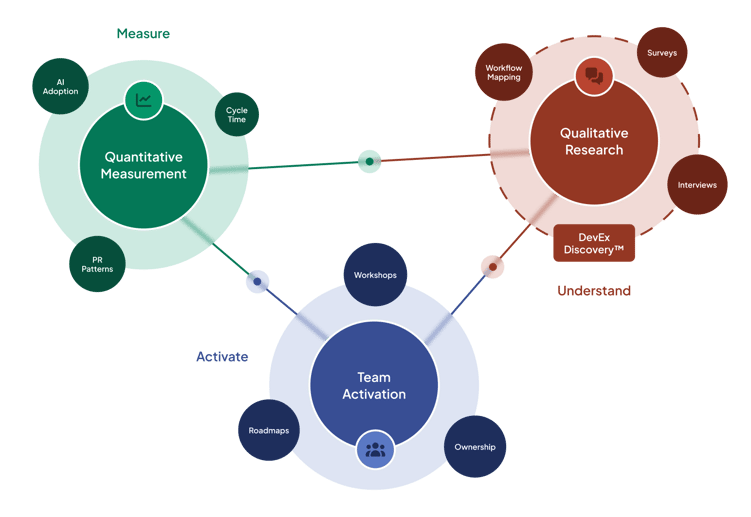
Quantitative measurement is the foundation — the signal that tells you where to focus in the engineering system. Cycle time, sprint velocity, unplanned work, PR patterns, and AI impact on all these metrics: these are the substrate. Any diagnosis that operates without this signal is working from “vibes.”
Qualitative root-cause research is what the data can't show on its own. Developer surveys and structured interviews surface context that quantitative signals don't capture: where requirements arrive unclear, where review complexity is absorbing the productivity gains from AI tools, where senior engineers are bottlenecked on work that shouldn't reach them. This is what DevEx Discovery™ is designed to produce — root causes surfaced through the data and validated with the engineers closest to the work.
Team activation is where findings become action. When engineers engage directly with data in team workshops, two things happen. First, the org gets better answers because the people closest to the work carry context that even good research doesn't fully surface. A roadmap engineers helped build carries different weight than one they received. They know where the bodies are buried. They built it; they own it. Second, the org builds internal muscle to keep improving after the engagement ends. The end goal of working with a consultant is to evolve beyond needing their help.
.png)
How do you evaluate a transformation partner?
Five questions separate partners that produce lasting change from those that produce well-documented recommendations.
-
Do they combine quantitative and qualitative signals, or work from one alone? Ground-truth technical data and developer context address different questions. A partner working from only one is making a diagnosis with half the information.
-
Do they build internal capability, or create a dependency on ongoing outside guidance? The measure of a well-designed engagement is that the organization gets better at running itself. Teams that leave an engagement better equipped to identify and solve their own problems compound that capability forward.
-
Do they help you make the internal case for the investment before the engagement begins? A partner should be able to translate engineering problems into P&L terms and help to secure executive buy-in for change as part of the engagement. Consider a staged engagement, where assessment and root cause analysis can secure investment for larger capability-building work.
-
Is measurement continuous, or structured as a one-time snapshot? A single assessment tells you where you are. Whether anything changed, and how to adapt as conditions shift, requires telemetry and infrastructure that runs after the sprint ends.
-
Do engineers engage directly with findings, or receive conclusions handed down from above? The organizations that sustain transformation are the ones where engineers understand and own the diagnosis. That ownership starts during the engagement.
Putting transformation principles into action
The three elements above are the design principles behind Uplevel's GearUp transformation sprint. GearUp is a 45-day engagement that puts all three into practice simultaneously — quantitative data ingestion, developer surveys and structured interviews, and team workshops that bring both signal streams together. The outputs are a sequenced AI transformation roadmap your team has helped build, along with an exec-ready ROI presentation grounded in what the data actually shows about your organization.
A tax compliance software company (~$1B revenue) illustrates what this looks like in practice. After deploying AI coding tools, the company saw meaningful gains in issue velocity — then hit a ceiling.
GearUp identified that the bottleneck had shifted: requirements clarity, testing approvals, and review complexity were absorbing the productivity gains. Senior developers reported spending up to half their time waiting, with a significant share of total capacity flowing to unplanned work. Uplevel identified opportunities to address cycle time and planning alignment representing an estimated $35M–$49M in combined capacity recovery and accelerated revenue delivery.

Every engagement starts with a baseline. Uplevel's StackUp assessment surfaces where your engineering organization stands before the sprint begins — what the quantitative signals show, where the most likely leverage points are, and what a GearUp engagement would likely prioritize. It takes about 10 minutes and produces a read you can act on regardless of what comes next.


.png)