
.png)
Engineering transformation programs rarely fail visibly. The tooling gets deployed, the process gets updated, the org chart changes. Then twelve months pass and the system is roughly where it started — same bottlenecks, different labels.
One reason (of several) is almost always sequencing. Most transformation efforts skip stages because the shortcuts look rational under short-term pressure: deploy AI tools now, build the foundation later.
But skipped stages compound.
Ariel Perez's research on structural drag makes the sequencing case in stark terms: most organizations invest in AI augmentation first and structural work last, which is the exact inverse of the leverage ordering. AI multiplies output but leaves the underlying economics unchanged. In high-drag environments, faster output accelerates the existing trajectory — toward the same collapse, but faster.
The five-stage journey Uplevel has mapped toward the agentic SDLC follows the correct leverage ordering: Benchmark → Identify → Implement → Build Permanent Capability → Agentic SDLC. Each stage creates the conditions the next one requires. Skipping one doesn't save time; it borrows against future progress at compounding cost.
.png?width=1600&height=444&name=Uplevel-process%20(1).png)
What is software engineering process transformation?
Software engineering process transformation is the work of changing how an engineering organization plans, builds, and ships — at the system level, across technical infrastructure, team design, practices, and governance.
Process improvement optimizes within the current system. Tool adoption adds capability without redesigning around it. Transformation changes the system itself.
The ultimate goal, however, is the agentic SDLC — a completely different concept and model of how software gets built. Getting there requires the journey below.
Stage 1: Benchmark your AI maturity
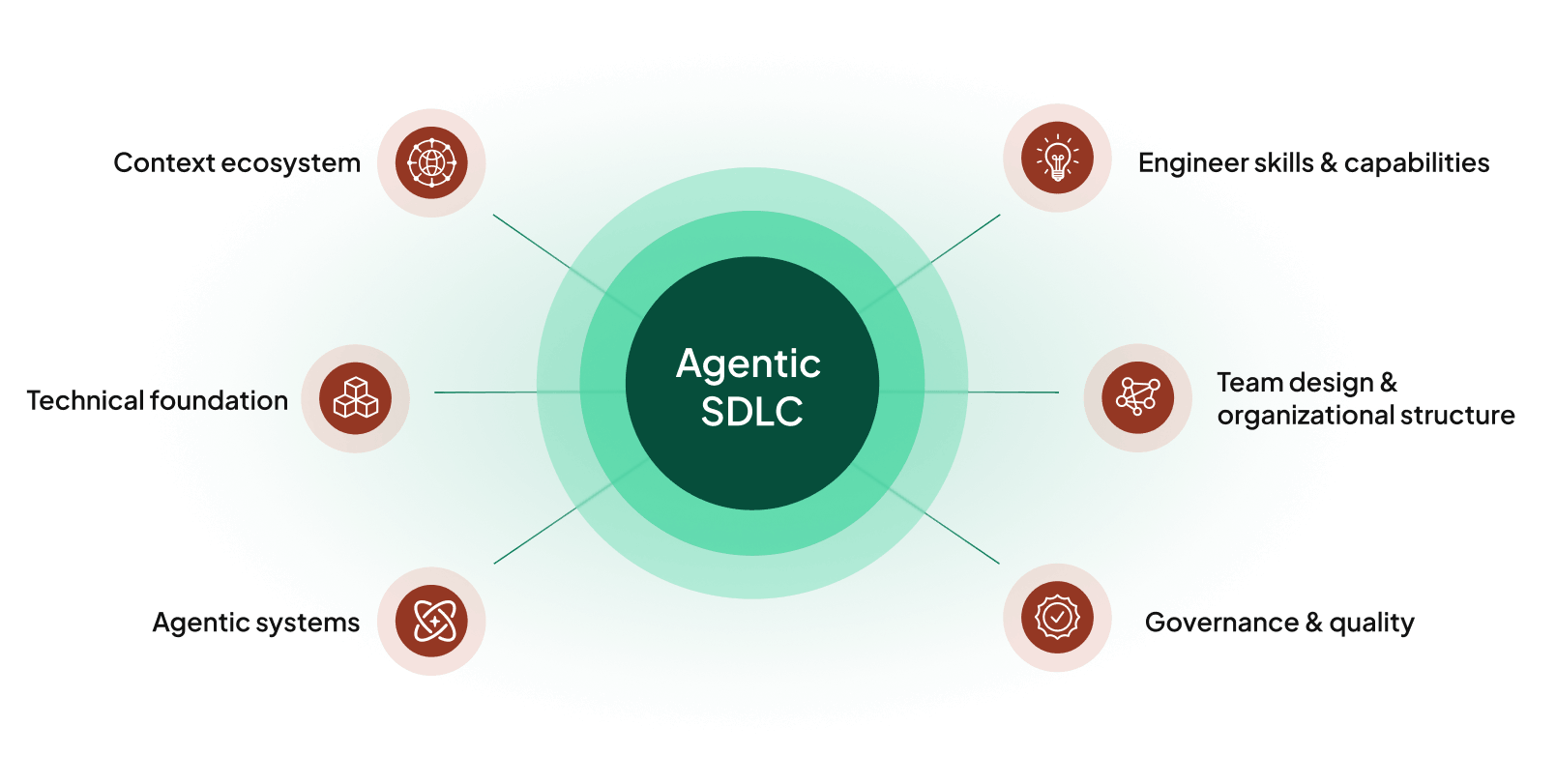
Benchmarking produces an honest picture of where your organization stands across the six transformation surfaces — technical foundation, context ecosystem, agentic systems, engineer skills, team design, and governance. Setting a benchmark is what makes every downstream decision defensible.
In Uplevel's experience, leaders consistently overestimate their organizations' AI maturity because adoption metrics look healthy while system health goes unexamined. Measuring what AI maturity actually requires for your organization means going deeper than dropping in AI tools or agents and tracking license usage and acceptance rates. It means knowing which parts of your system are likely to be constraints and which are levers for acceleration with AI-assisted development.
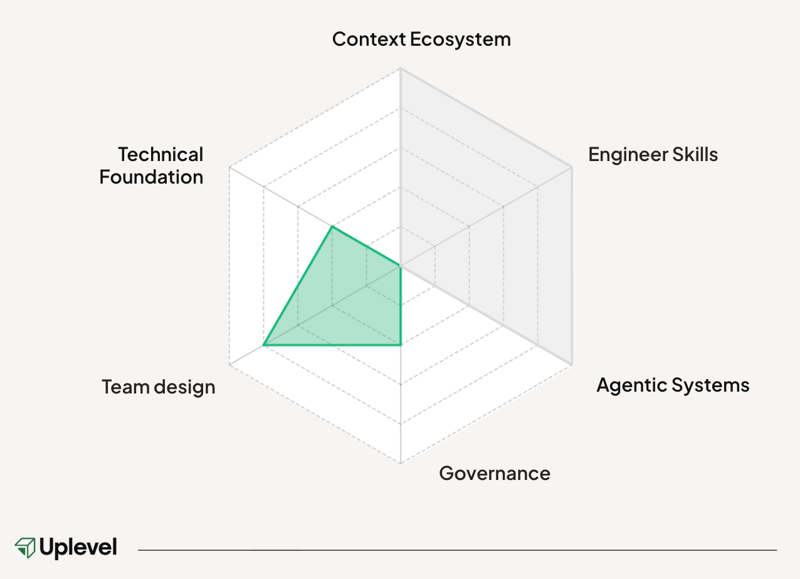
 A signal that Stage 1 is complete is that you have a general sense of how your org stacks up against mature engineering teams — and in what domains AI is the most likely to add friction rather than value.
Stage 2: Identify the highest-leverage opportunities
Identifying the highest-leverage opportunities means finding which surfaces are constraining the others — the ones that, if addressed, lift every downstream intervention.
Technical Foundation and Context Ecosystem are the two gates in Uplevel's six-surface model. Weak CI/CD infrastructure is the most commonly unexamined bottleneck: AI-accelerated code flowing into a fragile pipeline with manual QA produces accumulation. Uplevel's own research found a 41% increase in bug rates correlated with AI-assisted development. That's where the speed goes when the foundation can't absorb it.
The highest-leverage opportunities are rarely the most visible or politically convenient ones. Structural work — improving CI/CD reliability, maintaining accurate context, redesigning team boundaries — rarely makes a compelling roadmap slide. As Perez writes, "the benefits are diffuse and delayed while the costs are concentrated and immediate." That asymmetry is why getting engineering executive buy-in for structural investment requires translating engineering problems into P&L terms before the prioritization conversation happens.
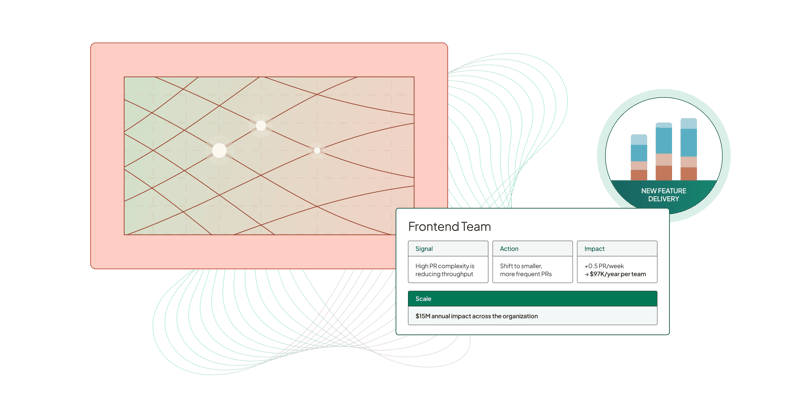
Surfacing these signals in a compelling and persuasive fashion requires deep context and a lot of data. Quantitative signals from engineering systems establish what is happening: AI adoption patterns, delivery health, quality indicators. Qualitative signals from the engineers doing the work establish why: where context is missing, where ownership is unclear, where governance standards are defined on paper and applied inconsistently in practice.
The signal that Stage 2 is complete: engineering leadership and the engineers closest to the work agree on the diagnosis and a prioritized roadmap is created, sequenced by leverage and grounded in the benchmark findings.
Stage 3: Implement targeted changes
Scope is where transformation programs lose momentum — broad mandates without diagnostic grounding stall at the point where prioritization becomes political. Specific, sequenced interventions with defined success criteria have a much greater chance of success.
Perez's modeling shows that teams running deferred cleanup strategies deliver less than two-thirds the output of teams with continuous improvement practices, and halt feature delivery entirely during recovery. The same dynamic applies organizationally: deferring structural work doesn't avoid it, it guarantees a more expensive version of it later.
Targeted also means involving the engineers closest to the work. Implementation that happens to teams rather than with them tends not to hold — the people who inherit it haven't stress-tested its assumptions against their actual constraints.
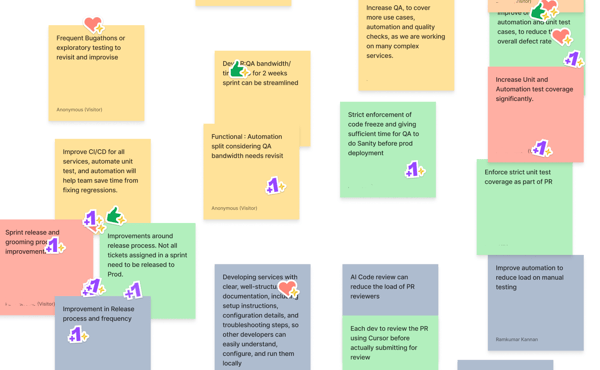
When engineers participate in reviewing data findings, pressure-testing root causes, and proposing solutions, the resulting changes are grounded in the reality of the system. Uplevel's 45-day GearUp sprint is structured around this: team workshops are where insights become actionable, and where the roadmap becomes something teams can actually run.
The signal that Stage 3 is complete: the targeted changes are holding under normal conditions, and the measurement baseline from Stage 1 shows sustained movement on the right leading indicators.
Stage 4: Build permanent capability
Permanent capability means the organization can identify problems, respond to them, and adapt as conditions shift — without outside help to restart the process.
Kent Beck's framing is useful here: he distinguishes "features" from "futures" — what ships now versus the organizational capacity to keep building. AI tools are good at features. They cannot manage futures.
Permanent capability has three components: measurement infrastructure that surfaces problems before they become expensive; standards that hold across teams without enforcement overhead; and team structures that absorb change without coordination collapse. Organizations that build this muscle are positioned to keep adopting AI deliberately as each new generation arrives. Organizations that run point deployments restart from zero each cycle.
The signal that Stage 4 is complete: the organization is identifying and responding to new problems without outside help.

What does the agentic SDLC actually look like?
The agentic SDLC is a reconceptualization of how software gets built — a fundamental change to roles, coordination, decision-making, and the definition of engineering work itself.
The old SDLC had alignment checkpoints built into its slowness. Planning meetings, draft PRs, Slack threads, review cycles — all of it created time for the team to stay roughly on the same page. Maggie Appleton at GitHub Next describes what happens when implementation collapses as a constraint: "That implementation window has collapsed. And because implementation is no longer as expensive and time-consuming, we think we don't need to plan as much."
Plugging agents into the existing SDLC produces volume without coordination — a compounding alignment problem that's harder to diagnose because the activity metrics look healthy while the coherence collapses.
What changes for engineers
Less time on implementation, more on problem framing, deciding what to build, and governing what agents produce. As Appleton puts it: "The hard question is no longer how to build it. It's should we build it. Agreeing on what to build is the primary constraint."
What changes for the organization
Teams structured around implementation handoffs accumulate friction when implementation is abundant and alignment is scarce. The org design, the tooling primitives, the governance model — all of it has to be reconceptualized around that constraint. The five-stage journey builds the organizational conditions — solid technical foundation, shared context, clear ownership, governance that holds — before the full weight of agentic development arrives.
What we do at Uplevel
Uplevel combines continuous measurement with contextual understanding and capability building to drive sustained engineering transformation.
StackUp is a free 45-minute session with an Uplevel expert. It covers where your AI spend is going and how your org compares to other engineering orgs, which gives you a benchmark to start from. For organizations ready to move from benchmarking to action, GearUp compresses the identify-implement-build sequence into a 45-day sprint with executive-ready outputs, grounded in both your engineering system data and qualitative signals from the engineers doing the work. Long-term we combine an engineering intelligence platform with capability building skills to help leaders reap the benefits of an agentic SDLC and adapt to ongoing change.
FAQ


.png)
![Top Engineering Intelligence Platforms [2026]](https://uplevelteam.com/hubfs/top-engineering-intelligence%20(1).png)