
Most engineering organizations have a working theory about what building AI capability means: get the licenses, drive adoption up, run an agent pilot. Some run hackathons. The more ambitious ones replace a human workflow with an AI one and call it transformation.
These are real moves. They're also working on one dimension of a problem that has six. The dimensions left unaddressed become the ceiling on the ones that get investment.
What "AI capability" actually means for an engineering org
AI capability at the organizational level is the ability to integrate AI into how teams plan, build, review, and ship — as a property of the system, at the team and org level.
An engineer who's good with Copilot has individual AI fluency. An organization with AI capability has something different: the technical infrastructure, shared context, team structure, and governance that let AI-assisted work compound across teams over time.
Ariel Perez at The Adaptive Alchemist cites an Anthropic study where developers who used AI to learn a new Python library scored 17 percentage points lower on a comprehension quiz than those who didn't — with the biggest gap in debugging. The mechanism: "AI multiplies whatever cognitive engagement you bring to the task. High engagement plus AI equals accelerated understanding. Low engagement plus AI equals accelerated ignorance."
Scaled to the org level, AI amplifies whatever trajectory the organization is already on. The right trajectory accelerates. The wrong one accelerates toward the wrong outcomes. Getting the trajectory right is an organizational problem. Tooling selection is downstream.
Why most enterprise AI strategies stall at the tool layer
Tooling is tractable. There's a vendor to call, a rollout plan to execute, a license count to report. Adoption metrics give leadership something to track: percentage of engineers using AI, code acceptance rates, time saved on boilerplate. These look good early, which is part of the problem.
A team reporting high AI adoption while experienced engineers spend significant time reviewing and correcting AI-assisted work is sending two signals at once. The adoption number is valid, but there is more rework. Throughput is up, but organizational capability may be declining. The metrics leadership trusts most are often the ones that leave this invisible.
Adoption metrics answer none of these questions, and in a fast-moving environment, unanswered questions become expensive surprises.
The six areas that determine whether AI compounds or stalls
Reaching the Agentic SDLC — where AI is integrated into the full software development lifecycle at the team and org level — requires progress across six transformation areas. Two of them are gates, and the rest compound on top.
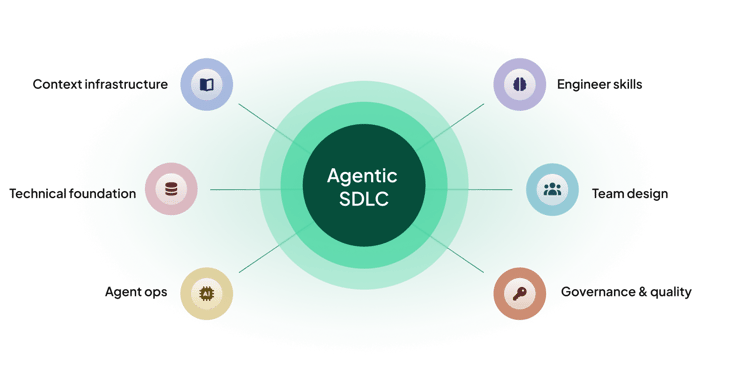
Technical Foundation is the prerequisite. Specifically: CI/CD, automated testing, automated compliance. AI-driven development generates code at a pace that manual QA pipelines weren't built to absorb. Uplevel's own research found that AI-assisted development correlated with a 41% increase in bug rates — code moving fast into a fragile pipeline accumulates. Most enterprises have manual QA somewhere in the pipeline. That's the actual gate.
Context Infrastructure is the second gate. It's the documentation, architecture records, service boundaries, and shared conventions that give AI accurate information about your specific system. Maggie Appleton at GitHub Next calls the failure mode "zero alignment": when agents — or developers and agents working in parallel — each operate from their own isolated context window, with no shared understanding of decisions made or work in progress, you get confident activity moving in multiple directions simultaneously, with no coherence. This creates conflicts, duplication, outputs that are locally plausible but globally wrong. Context is the shared ground truth that makes coordinated work possible at scale.
Agent Ops covers the infrastructure for running AI agents in production: orchestration, monitoring, failure handling. Most organizations have prototyped agents. Few have the operational backbone to run them reliably at scale. This is where pilots stall out.
Engineer Skills and Capabilities goes beyond prompt fluency. Engineers need to know when to stay in the reasoning loop and when to delegate — and organizations need shared standards for how AI-assisted work gets written, reviewed, and accepted. AI also opens up new needs for capabilities like structural thinking and taste: the judgement and critical thinking required to determine whether something that can be built should be built, and what constitutes quality.
Team Design and Organizational Structure is where most transformation plans have the largest blind spot. As AI makes certain kinds of full-stack autonomy more feasible, teams built around handoff-heavy workflows find that the handoffs become the bottleneck — regardless of what tools the individuals are using. The org design has to evolve alongside the tooling, or the tooling just accelerates the existing friction.
Governance and Quality determines whether engineering standards hold when AI wrote the code. Who is accountable for outcomes? How is AI-assisted work reviewed before it ships? How are those standards maintained across teams as AI capabilities and usage patterns change? Without clear answers on ownership, quality becomes inconsistent even when tooling is uniform.
AI is changing how engineering teams should be structured — roles, ownership, and coordination models all included. As full-stack autonomy becomes more feasible for individual contributors, the inherited ways of organizing teams create friction the tools alone can't resolve.
Which areas are you treating as optional?
Most engineering organizations are actively working on Engineer Skills and, if they're further along, Agentic Systems. The foundational surfaces tend to be assumed rather than intentionally built.
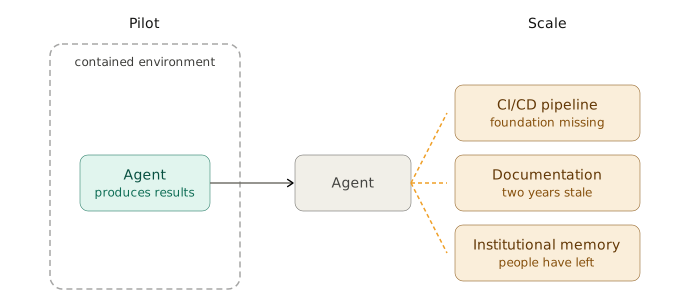
The hackathon problem is a symptom of this. An organization runs an agent pilot, results look promising in a contained environment, and leadership concludes the capability is there. Then they try to scale. The CI/CD foundation that would let agents ship reliably doesn't exist. The context the agents need to make accurate decisions is scattered across documentation last updated two years ago and the institutional memory of people who've left. The pilot may have worked, but that doesn’t mean the system can absorb it.
Headcount replacement is a different version of the same trap. Replacing a human workflow with an agent without redesigning the surrounding team structure leaves ownership ambiguous for what the agent produces. Speed goes up, but accountability becomes unclear. The first production incident reveals the problem.
Working all six surfaces simultaneously from day one is a false target. The goal is to know which surfaces you're neglecting and make that a deliberate choice.
Do you know where your organization actually stands?
Most organizations assess AI capability by looking at adoption metrics: license usage, code acceptance rates, time to first commit. These measure activity on one surface while leaving Technical Foundation maturity, context quality, governance standards, and team structure largely unexamined.
Getting an accurate picture requires quantitative signals and qualitative ones together — what the data shows and what engineers close to the work actually experience.
Uplevel is built to surface the full picture across the factors that determine whether AI investment compounds. In addition to traditional quantitative metrics, DevEx Discovery™ adds the qualitative layer: structured developer surveys and interviews that surface root causes the quantitative data alone won't show.
Uplevel combines continuous measurement with contextual understanding and capability building to drive sustained engineering transformation. Start with StackUp, a free 45-minute session with an Uplevel expert. You'll see where your AI spend is going and how your org compares to other engineering orgs.
FAQs


.png)

![Top Engineering Intelligence Platforms [2026]](https://uplevelteam.com/hubfs/top-engineering-intelligence%20(1).png)