Seats, activity counts, and adoption rates are metrics that every tooling vendor makes easy to report. The harder question is whether any of it is moving outcomes: delivery speed, quality, the ratio of engineering capacity going toward work that actually matters.
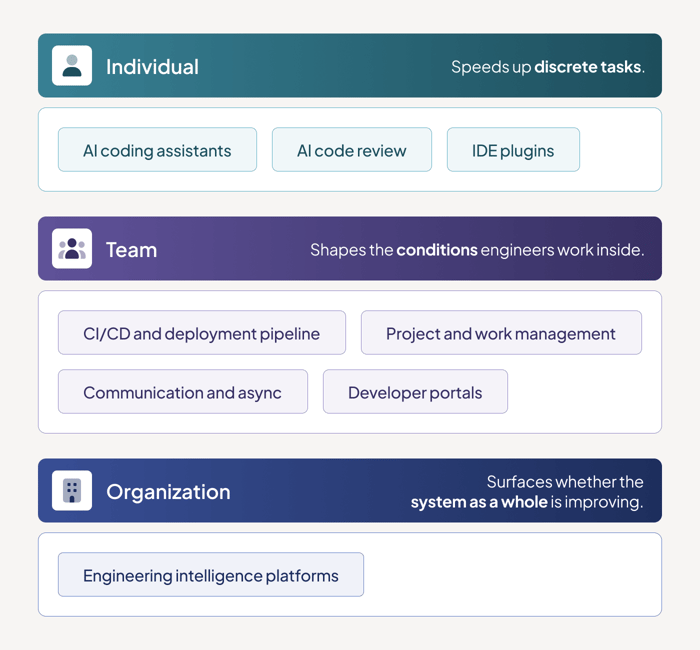
That question is harder to answer partly because developer productivity tools don't all do the same thing. They operate at three distinct layers of the engineering system, each with a different mechanism and a different relationship to outcomes. Treating them as interchangeable — buying more tools in the layer that's easiest to instrument when the constraint lives somewhere else — is how organizations end up with impressive adoption dashboards and unchanged delivery.
What are developer productivity tools?
Developer productivity tools are software products that help engineering organizations ship software faster and sustain the pace over time. The category spans everything from AI coding assistants that accelerate individual output to engineering intelligence platforms that surface whether the system as a whole is improving over time — and what developer productivity actually means determines which layer of that spectrum holds the binding constraint.
The three layers — individual output, team environment, and sustained organizational improvement — are distinct enough that developer productivity software designed for one layer rarely substitutes for the others, and the problems they solve compound in that order. Individual speed that the team environment can't absorb produces volume without throughput. Team environment investments that the organization can't measure produce effort without direction.
Tools that accelerate individual output
These tools operate at the individual engineer layer, speeding up discrete tasks: writing code, reviewing it, testing it. AI has accelerated development here faster than anywhere else in the SDLC, which is why the individual output layer attracts the most investment and the most scrutiny. It's also the layer where the distance between what gets measured and what matters is sharpest.
AI coding assistants
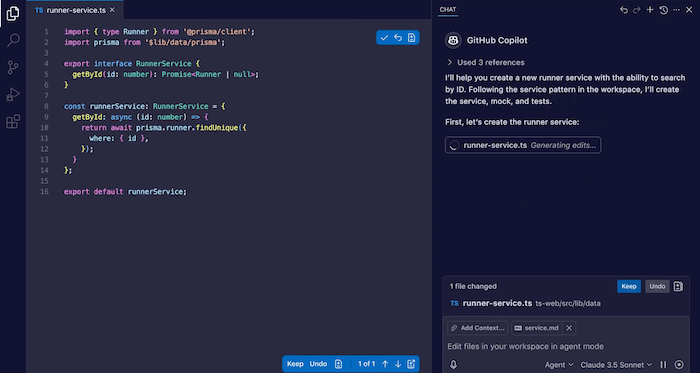
GitHub Copilot, Cursor, and Claude Code are the most widely deployed examples. Individual speed gains are measurable — a large-scale Microsoft Research study of tens of thousands of engineers found that developers using AI coding agents merged roughly 24% more pull requests, sustained across a four-month window.
The same researchers note explicitly that a merged PR is not the same as the value it delivers. A high-impact feature and a minor internal fix are both PRs — so is AI-generated code that passes review without delivering anything meaningful. More merged PRs means more volume. Whether that volume reflects value depends entirely on what's in those PRs and whether it's aimed at the right problems.
The value of these tools also scales with the judgment the engineer brings to evaluating their output. A senior engineer with deep context in the codebase and years of experience debugging production failures will catch what AI gets wrong. A less experienced engineer working in an unfamiliar system will accept more of it — which is precisely when the verification tax is highest and the risk of compounding errors is greatest.
AI code review tools
Tools like CodeRabbit and GitHub Copilot code review automate first-pass review, flagging potential issues before human reviewers see them. They reduce the latency between code submission and first feedback, which tends to shorten PR cycle time at the individual level.
The trade-off is the same as with coding assistants: engineers still need the judgment to evaluate AI-generated review feedback, and over-reliance on automated review without developing that judgment creates a different version of the same skill-atrophy risk. Review is one of the primary mechanisms through which engineers learn from each other's work. Automating it wholesale changes what knowledge gets transferred.
IDE plugins and developer tooling
Autocomplete and test generation tools reduce friction at the task level. Their value depends heavily on fit with existing workflow — a tool that interrupts focus to surface suggestions engineers reject 80% of the time costs more in concentration than it returns in speed. The tools that compound tend to be the ones engineers reach for voluntarily because they solve a friction point that was already slowing them down.
Tools that improve the team environment
These tools shape the conditions engineers work inside — the pipeline, the planning process, the communication patterns, the internal infrastructure. Gains available here are directly proportional to the investment already made in the foundation. Any of these tools can accelerate delivery or sabotage progress depending on how they're implemented and what they're built on.
CI/CD and deployment pipeline
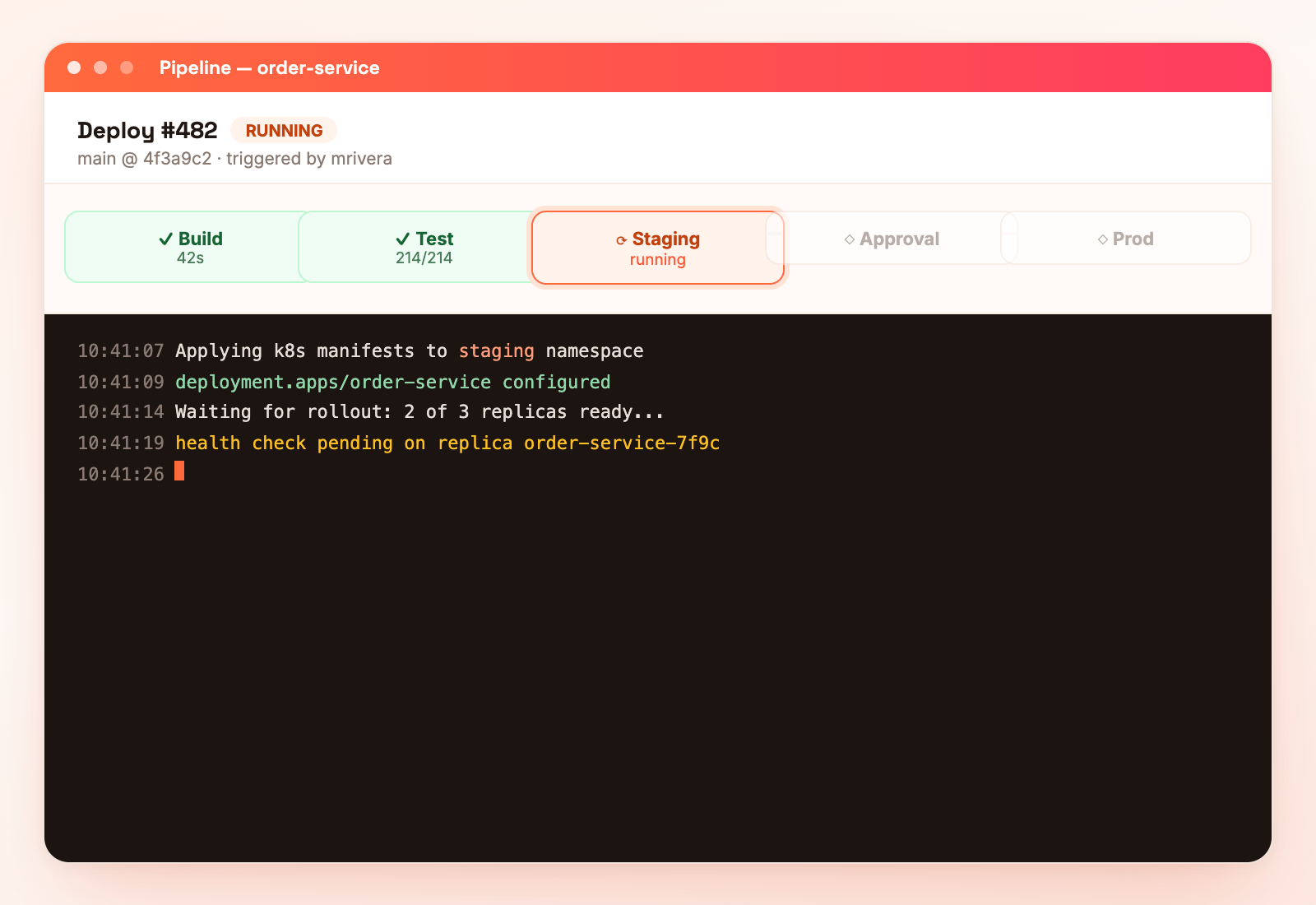
GitHub Actions, CircleCI, Argo CD, and their equivalents are intended to reduce deployment friction and give teams confidence to ship frequently. The organizations Uplevel works with that have invested in standardized "golden pipelines" — a single vetted, reusable template encoding security scanning, testing gates, and deployment steps — often find the template wasn't built to handle what an agentic SDLC produces. Pipelines designed for human-authored commits can fail when exposed to AI-generated volume. The result is often test parallelization and approval gates that become bottlenecks at scale.
When AI-generated code volume increases faster than the pipeline's review and validation capacity, the bottleneck shifts from development to deployment, and a pipeline that used to be a strength becomes a constraint.
The question for any CI/CD investment (tooling and process) is whether the pipeline is built to handle the volume and composition of work an AI-augmented team produces — including the higher rate of edge cases and subtle errors that automated code generation tends to surface in production.
Project and work management
Linear, Jira, and similar tools shape how work gets defined, prioritized, and tracked — but like pipeline tools, they also reflect the quality of the process beneath them. A work management system built on unstable requirements and unclear ticket definitions produces a clear picture of the wrong things. The same patterns Uplevel finds in allocation data — engineering capacity drifting from stated priorities over weeks before anyone notices — show up regardless of which work management tool is in place.
The tools that sustain delivery tend to be the ones adopted alongside stronger planning practices, where the tool reinforces a planning process that already works.
Communication and async tools
Slack, Loom, and async documentation tools shape interruption load — the degree to which engineers can sustain the uninterrupted focus blocks that predict output quality. The tool itself is neutral — how it's used determines whether it protects concentration or destroys it. When an engineering organization that adopted Slack to reduce email ends up with a faster-moving stream of context-switching requests, they've exchanged one interruption pattern for another.
This is the category where behavior and norms matter more than feature selection. The tool is rarely the binding constraint.
Developer portals and internal tooling
Cortex and similar internal developer portals reduce the context-switching cost of navigating large engineering organizations — finding the right service, the right documentation, the right owner. For organizations running hundreds of developers across dozens of teams, the time spent on internal wayfinding is a measurable drag on capacity. Developer portals address that drag by giving engineers faster access to the infrastructure they need without leaving their workflow.
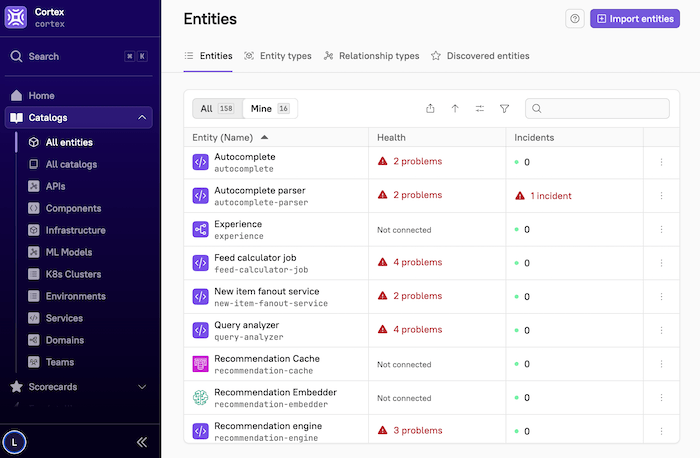
The investment case in context infrastructure strengthens as AI agents become part of the SDLC — agents navigating poorly documented systems produce worse outputs than agents with direct access to the context they need.
Tools that support sustained engineering improvement
These tools operate at the organizational layer — surfacing how work moves through the system, where it stalls, and whether the conditions that predict delivery performance are getting stronger or degrading. This category is engineering intelligence platforms, where implementation matters as much as the product selected.
Engineering intelligence platforms
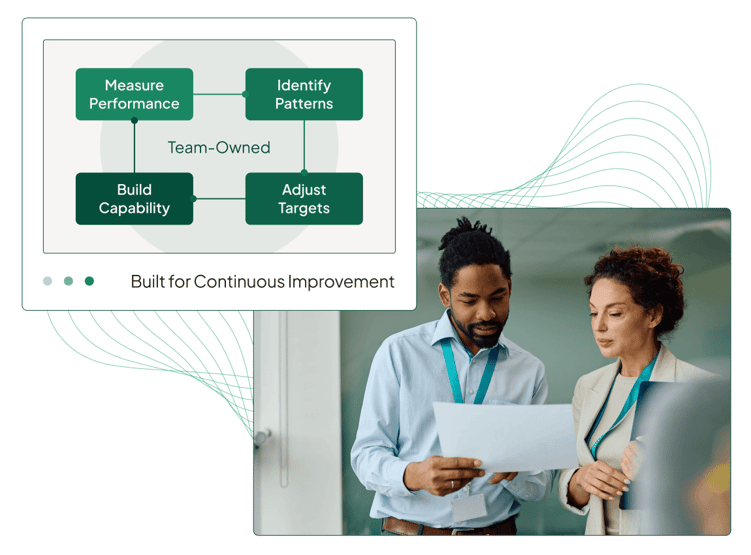
The category promise is coherent: aggregate signals from across the engineering system — code repositories, issue tracking, CI/CD pipelines, calendar, communication tools — to give leaders a picture of engineering health that no single tool's native analytics can provide.
Implementation reality varies. An engineering intelligence platform set up to consolidate the same signals already available in individual and team layer tools — GitHub Insights or Jira reporting views — delivers a single pane of glass over those layers. That's a convenience improvement, but not much else. The native analytics in those tools or in internal developer portals already measure the layer they live in. Consolidating them without adding analytical depth above that layer produces a more expensive version of a picture the tools already show.
Quantitative data surfaces what's happening. Qualitative data explains why. An organization acting on quantitative signals without the qualitative context often addresses the symptom while the underlying condition persists.
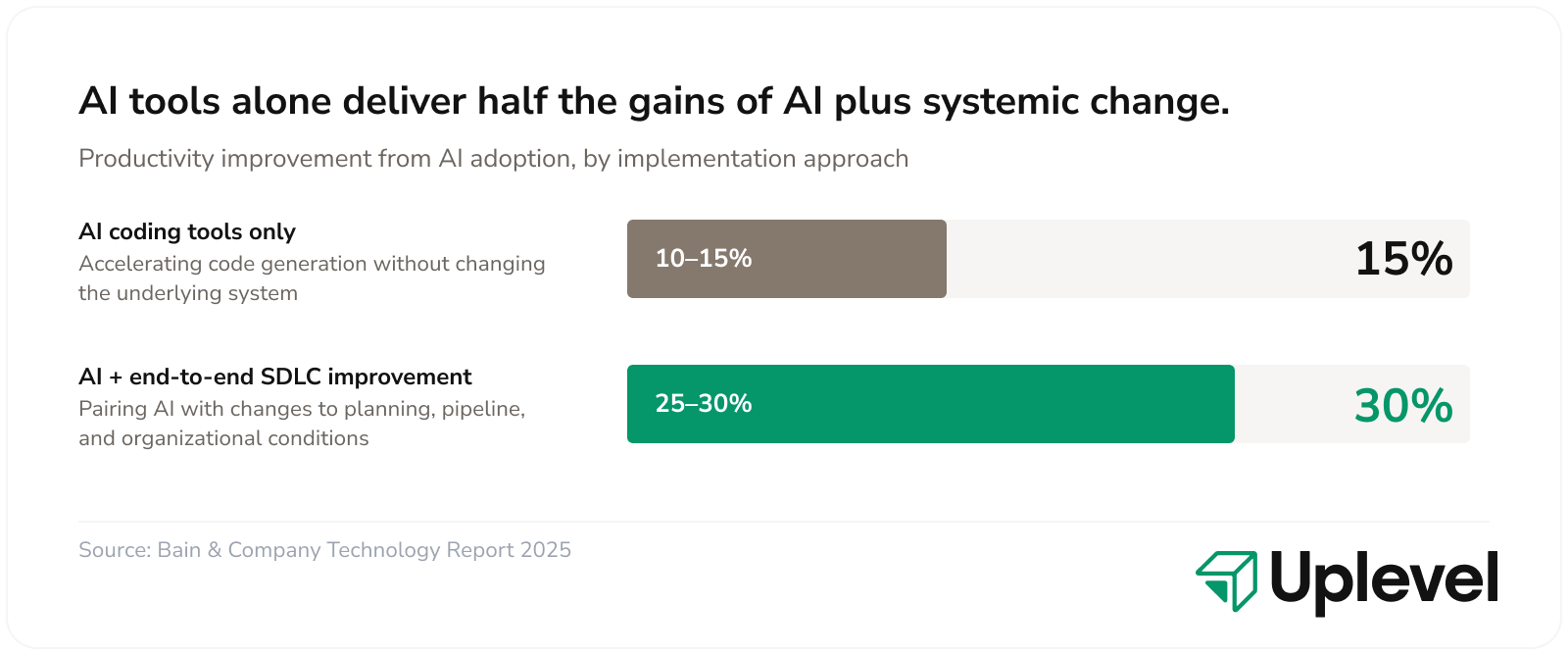
The difference in outcomes between these two implementation modes is measurable.Bain's Technology Report 2025 found that teams using AI coding tools alone see 10–15% productivity gains. Teams pairing AI with end-to-end process transformation — which requires the organizational-layer visibility and active improvement methodology that a well-implemented engineering intelligence platform provides — report 25–30%. The tool category is the starting point. The system and the methodology surrounding it determine the outcome.
.png)
How the three layers work together
The three layers of developer productivity tools are interdependent, and the relationship runs in both directions.
- Individual-layer tools produce speed.
- Team-environment tools create the conditions for that speed to move through the pipeline
- Organizational-layer tools surface whether the system is converting both into outcomes, and what to change when it stalls.
Unfortunately, there’s a common pattern that makes these tools fail to produce sustainable engineering effectiveness. It looks like heavy investment in the individual output layer, significant but poorly-architected investment in the team environment layer, and organizational-layer tools that end up doing passive reporting because they are not set up to turn data into action.
Choosing tools without understanding which layer holds the bottleneck produces the wrong investment at the right price point. An engineering organization generating code faster than its pipeline can validate it needs team environment investment. One with a well-built pipeline and a roadmap that engineering effort has drifted away from needs organizational intelligence. The tool selection follows the diagnosis — and the diagnosis requires looking at the full system.
How Uplevel approaches sustained engineering improvement
Engineering leaders working with Uplevel typically arrive with significant investment in the individual and team layers — AI coding tools deployed, pipelines built, work management systems in place — and limited visibility into whether any of it is compounding into organizational performance or plateauing.
Uplevel combines continuous measurement with contextual understanding and capability building to drive sustained engineering transformation. That means tracking where focus time is eroding, whether engineering capacity is going toward stated priorities, and how quality is trending as AI adoption changes the composition of the work — alongside qualitative interviews that explain why the patterns exist. The measurement tells leaders what's happening at the organizational layer. The qualitative work tells them what to do about it. The capability-building component builds the organizational muscle to keep improving after the initial engagement.
Uplevel's evaluation criteria for engineering intelligence platforms covers what actually predicts whether a platform drives change, and a direct comparison of the leading platforms covers the category in detail.
Frequently Asked Questions


.png)