
Most developers use coding assistants daily, yet only 25% of AI initiatives deliver on promised ROI. AI amplifies existing organizational patterns — teams with mature practices multiply velocity, while teams without them accumulate AI-generated code that waits for review, fails integration tests, or triggers security flags. With 62% of AI-generated solutions containing bugs or security vulnerabilities, the challenge is systemic, not technical.
Engineering leaders face organizational constraints that limit what AI can accelerate.
The tools below represent different approaches to AI-enabled development. They won't enable successful AI adoption alone, as that’s a sociotechnical challenge that requires changes to technology choices and to how organizations work. But they do help to force some of the necessary decisions about ownership, process, and quality gates — revealing how work flows and what quality means when AI generates code faster than humans can evaluate it.
1. Greptile
Category: Code Review & Context
Key features for AI adoption:
- Full-codebase context indexing treating codebases as interconnected graphs of functions, classes, files, and dependencies
- Agentic code review with multi-hop investigation across git history
- AI code summarization generating plain-English PR summaries and call flow diagrams
How Greptile enables AI capability:
Understanding business logic and broader context is critical — without codebase context, AI tools can't distinguish intentional patterns from mistakes. As AI generates more code, Greptile traces the full stack of changed functions to diagnose potential bugs and detects inconsistencies with existing patterns.
More than 2,000 organizations including NVIDIA, Brex, and Coinbase use Greptile to maintain review quality while handling increased volume. It helps organizations accelerate their AI capability when they use it to standardize baseline quality checks while reserving senior engineers for architectural concerns.
2. Productboard
Category: Requirements Intelligence & Prioritization
Key features for AI adoption:
- Centralizes customer feedback from multiple sources into single repository
- Prioritization frameworks (RICE, WSJF, ROI) linking customer data with business impact
- Interactive roadmaps connecting requirements to delivery
How Productboard enables AI capability:
AI coding assistants generate code from requirements — and vague requirements produce vague code. When AI can build anything, teams struggle to decide what to build. Productboard forces the critical prioritization question: which customer problems justify investment when development capacity expands?
Over 6,000 companies including Microsoft and Zoom use Productboard to establish clarity before AI generates code. AI-powered Productboard Spark synthesizes feedback 6x faster than manual analysis, making it easier to build what customers need. The platform treats requirements as strategic inputs to AI systems. Teams that skip this clarity find AI builds the wrong features faster.
3. TeamForm
Category: Team Coordination
Key features for AI adoption:
- Human-AI team visualization across people, skills, teams, strategy, and finance
- AI agent registry integrating agents as team members
- Agent context provision understanding team structures and work
How TeamForm enables AI capability:
TeamForm supports over 30,000 teams in sectors like banking, telecom, and retail, enabling organizations to plan agent import from providers like Cursor and AWS AgentCore.
The platform helps navigate the era of Human-AI teams where humans and AI agents work more interdependently. TeamForm helps leaders visualize where AI agents fit into team structures and measure their impact — treating AI agents as team members requiring coordination and strategic alignment.
4. Uplevel
Category: Engineering Intelligence & Organizational Transformation
Key features for AI adoption:
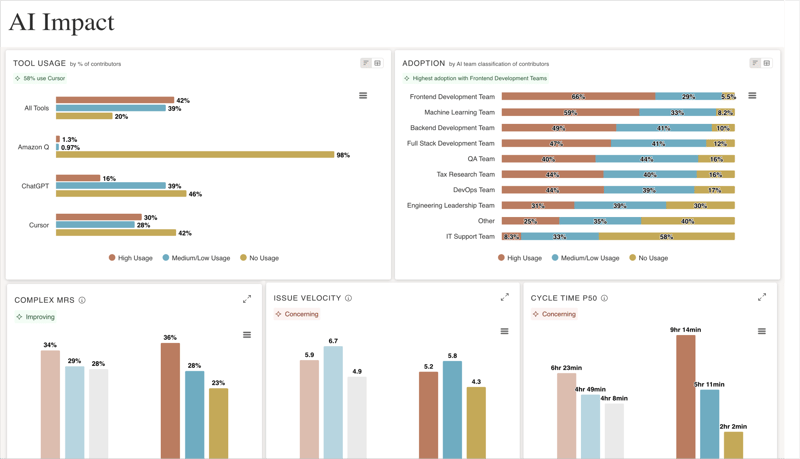
- AI Impact measurement tracking across the entire value stream
- WAVE framework (Ways of Working, Alignment, Velocity, Environmental Efficiency) diagnosing issues systematically
- Bottleneck identification revealing process constraints preventing AI gains
- Hands-on transformation support combining metrics with capability building
How Uplevel enables AI capability:
While other tools enable specific capabilities, Uplevel helps leaders understand whether AI improves outcomes and identifies the process constraints that prevent promised gains. The platform combines engineering metrics with transformation support, helping teams to understand which organizational changes create the most leverage.
Uplevel's WAVE framework provides structure for diagnosing sociotechnical issues and building organizational capability to adapt as AI evolves. Organizations succeed when they use Uplevel to identify and remove constraints before deploying additional AI capabilities — ensuring AI investments deliver sustained value rather than temporary productivity spikes.
5. Endor Labs
Category: Security & Governance
Key features for AI adoption:
- AI model discovery searching thousands of models with security and integrity evaluation
- AI Security Code Review examining every pull request for architectural security risk
- MCP server integration scanning in IDEs to catch vulnerabilities before production
- Policy engine to warn or block high-risk AI components
How Endor Labs enables AI capability:
Nearly 30% of AI-generated code includes critical security weaknesses, and analysis found only 1 in 5 dependency versions recommended by AI assistants were safe to use. Endor Labs trains AI agents using both scanning tool data and software engineering expertise, functioning as developers, architects, and security engineers working in concert.
With Endor Labs, organizations can shift security left. Enabling developers to catch issues during development prevents security from constraining AI productivity gains.
6. Backstage
Category: Developer Portal
Key features for AI adoption:
- Software catalog centralizing service discovery, documentation, and tooling
- Golden paths for AI projects ensure that new models or data applications are created with best practices
- Integrated AI Knowledge Assistant (AiKA) and service maturity scoring
How Backstage enables AI capability:
Backstage’s centralized “single pane of glass” interface becomes critical as AI tools proliferate across teams. A robust ecosystem of plugins allows for more dev work to happen in one place, reducing developer experience problems like context switching, fragmentation, and cognitive load.
7. git-ai
Category: Attribution & Compliance
Key features for AI adoption:
- Line-level attribution linking each code line to the prompt that generated it
- Git-native tracking through Git Notes
- Vendor-agnostic support for Claude Code, Cursor, and Copilot
- Workflow analytics showing which AI code became durable and which prompts led nowhere
How git-ai enables AI capability:
Organizations increasingly need provable records of what code is AI-generated and from which models. From the EU AI Act phasing in 2026 and SOC2/ISO audits increasingly requiring transparency about AI system usage to due diligence during M&A or funding, stakeholders need concrete data on codebase composition.
Git-ai has coding agents mark exactly which lines they generated at commit time, creating an auditable chain of custody that legal teams can trace during IP disputes and security teams can query during incident response. With git-ai, orgs can treat AI code attribution as a governance requirement rather than a nice-to-have. It’s best practice to establish the same audit trail for AI-generated code as they maintain for third-party dependencies while preserving valuable context about code provenance for future investigations.
8. CodeScene
Category: Quality & Debt Prevention
Key features for AI adoption:
- Real-time AI Code Guardrails to validate that AI-assisted code remains readable and maintainable
- CodeHealth™ metric aggregating 25+ contextual factors of code quality to identify likely hotspots needing attention
- Auto-refactoring (ACE) fixing technical debt with one click
- IDE integration detecting code smells before code is merged
How CodeScene enables AI capability:
Popular AI assistants generate correct code in only 31% to 65% of cases. (This checks out; Uplevel’s own research found that bug rate increased by 40% with AI-generated code.) CodeScene helps organizations prioritize technical debt according to code health and hotspots (where development activity is occurring) in order to make sure that any remediation is necessary and impactful, not just refactoring for “fun.”
CodeScene is most effective when organizations establish code health requirements before applying AI assistants — treating code quality as a prerequisite for AI usage rather than cleanup after generation.
9. Datadog
Category: Observability
Key features for AI adoption:
- AI Agent Monitoring mapping each agent's decision path in interactive graphs
- LLM Experiments testing impact of prompt changes and model swaps
- AI Agents Console with security and compliance checks
- Sensitive data scanning and prompt injection identification
How Datadog enables AI capability:
Unpredictable AI tooling introduces new risk and monitoring challenges. Datadog provides critical visibility across the AI stack, supporting development, staging, and production. The platform enables teams to accelerate deployment and scale reliably by overcoming LLM chain complexity and security risks.
Datadog helps teams to build AI capability by establishing monitoring infrastructure before deploying AI at scale, treating AI application monitoring as essential for production deployments.
10. Glean
Category: Knowledge Access
Key features for AI adoption:
- Enterprise knowledge graph building connections between company content, people, and interactions
- Code intelligence providing automatic function discovery and dependency mapping
- Agentic assistant coordinating sub-agents across company tools
- AI agents builder supporting LangChain, OpenAI SDK, Bedrock Agents via remote MCP server
How Glean enables AI capability:
80% of enterprise data is unstructured and expanding at an incredible rate. Glean significantly reduces the time developers spend searching for code examples or understanding legacy systems through modern code intelligence capabilities.
Glean helps organizations treat enterprise knowledge as infrastructure that AI agents require to function effectively, rather than assuming general-purpose models can operate without organizational context.
11. LaunchDarkly
Category: Experimentation
Key Features for AI Adoption:
- AI experiments and configs to test different models, prompts, and configurations against each other
- Safe rollouts and kill switches to instantly revert if AI-generated code behaves unexpectedly
- Leverages AI agents to monitor flag patterns, identify anomalies in AI behavior, and automate rollbacks.
How LaunchDarkly enables AI capability:
Feature flags are the control point that makes progressive delivery, monitoring, and experimentation possible across the AI stack. Building capabilities for testing into delivery allows rapid iteration and validation of different AI models and prompts. One LaunchDarkly customer achieved a 97% reduction in overnight releases while enjoying a 300% increase in production deployments.
12. Pendo
Category: Behavioral Intelligence & Product Analytics
Key Features for AI Adoption:
- Session replay showing exactly what users were doing when they submitted feedback
- In-app feedback collection connecting user requests to usage patterns
- Agent Analytics measuring AI agent performance and user interaction
How Pendo enables change:
Customer requests don't always reveal actual needs, and AI can rapidly build requested features that users never adopt. Pendo combines what users say (feedback) with what they do (behavioral data), preventing AI-generated features nobody uses. When users request features, session replay reveals what they were actually trying to accomplish — preventing AI from generating solutions to misunderstood problems.
From Tools to Transformation
AI capability is a practice, not a product. The tools above create infrastructure for AI-enabled development, but they only deliver ROI when organizations address the sociotechnical changes they demand.
Start with understanding your current state: Where are your bottlenecks? What will AI amplify — your strengths or your dysfunction? What organizational changes are required to benefit from faster code generation?
The highest ROI comes from removing organizational constraints and building flexibility in how teams work. AI tools succeed when they eliminate handoffs, reduce wait time, and enable teams to own more of the value stream. Build the enabling infrastructure, address the organizational constraints, and then let AI multiply what you've created.
Ready to understand your organization’s ability to maximize AI impact? Start with an Uplevel assessment. In 45 days and with no infosec required, you’ll uncover the organizational bottlenecks that keep you from seeing AI benefit.


.png)
.png)