
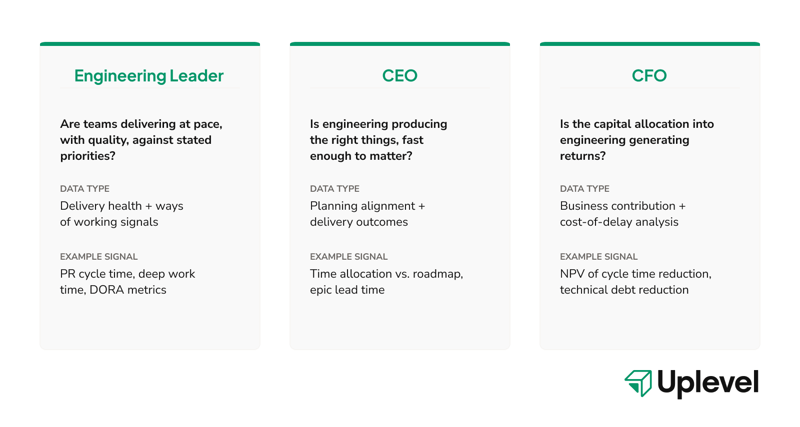
Engineering effectiveness means something different depending on where you sit. Ask an engineering leader and you'll hear about delivery throughput, cycle time, and focus time. Ask their CEO and you'll hear about cost justification, revenue, and whether the organization is building the right things fast enough.
Neither answer is wrong. But the distance between them is what makes engineering effectiveness hard to act on — and what causes most measurement programs to produce reports nobody outside engineering reads. Closing that distance requires treating effectiveness as a business problem, with the right financial framing and organizational context.
Why engineering effectiveness is hard to define
Will Larson, drawing on years of advising engineering executives, says the most common mistake engineering leaders make when presenting to a CEO or board is sharing optimization metrics — developer throughput, cycle time, PR velocity — in response to a business-contribution question. Optimization metrics are meaningful to engineering leaders because they understand the connection to delivery. A CEO without that context sees a number with no obvious link to revenue, cost, or strategic progress.
The data is accurate, but it answers an engineering question while the executive is asking a business one.
What engineering effectiveness actually measures
Engineering effectiveness is the organization's ability to convert engineering investment into business outcomes — features shipped against priorities, time from decision to delivery, quality sustained over time, capacity available for new work relative to maintenance obligations.
What makes it hard to measure is the organizational layer between engineering signals and business results. That middle layer — the conditions that determine whether engineering effort converts productively or leaks out through planning friction, unplanned work, and rework — is what most measurement programs skip. Once you have that data, the next question is how to connect it to the financial conversation executives are actually having.
Connecting developer effectiveness to business outcomes
Kent Beck makes an argument in The Pinhole View of AI Value that applies directly here. The dominant executive framing of engineering investment — and AI investment specifically — treats labor cost as the primary value lever: can we do more with fewer people? Beck identifies three other NPV levers that this framing misses.
- Deferred costs: engineering work that reduces future rework, technical debt, or maintenance obligations has financial value that doesn't show up in current-period metrics but represents measurable cost avoidance.
- Increased revenue: more reliable software, fewer incidents, higher product quality — these affect revenue, customer retention, and renewal rates.
- Earlier revenue: a week of cycle time reduction on a significant product launch has a calculable NPV at any reasonable discount rate.
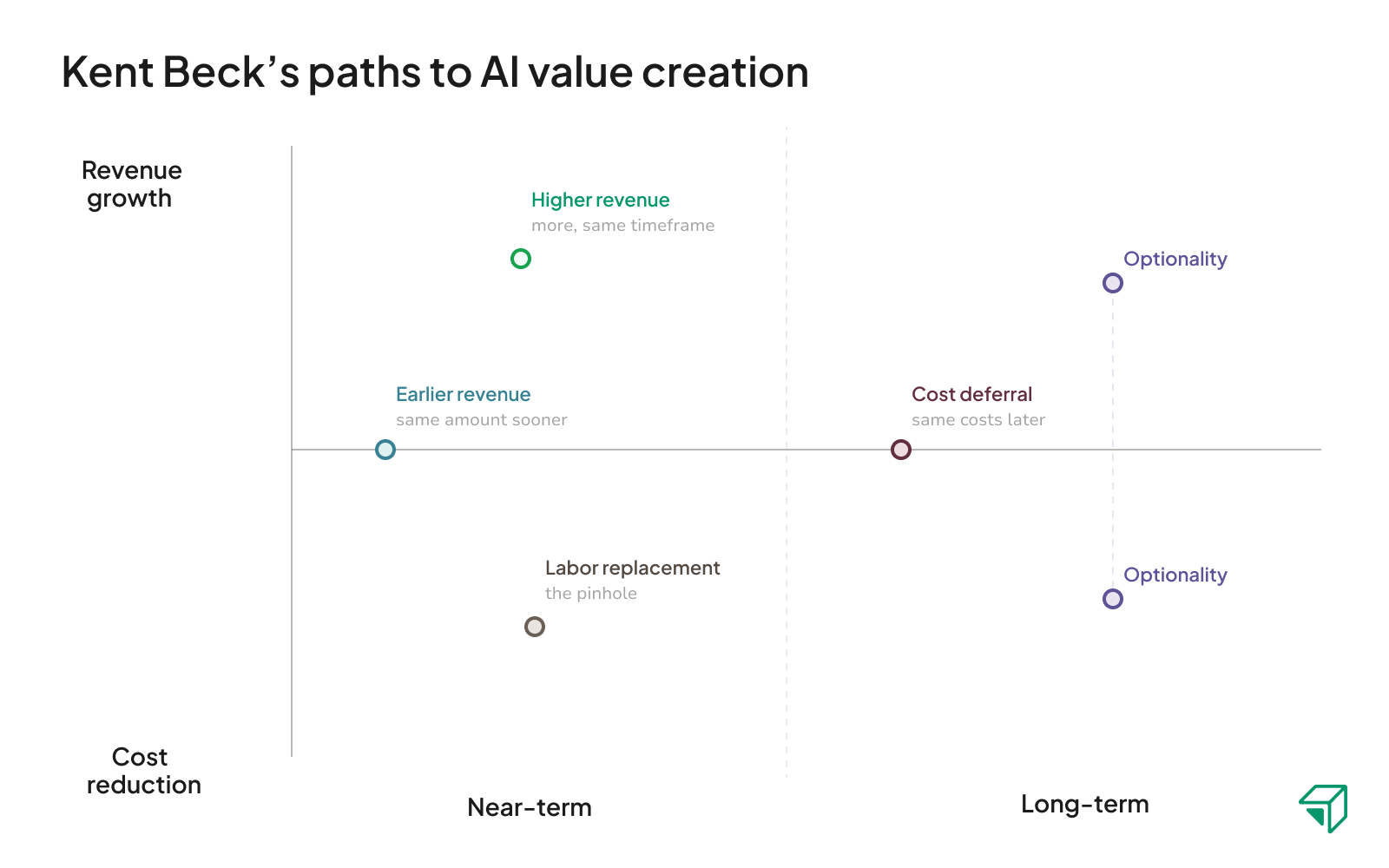
The organizational conditions that drive engineering effectiveness map directly to those other levers. Effort allocation tracking tells you whether engineering capacity is going to the highest-value priorities (increased revenue, earlier revenue). Environment health and code quality signals track the conditions that drive future maintenance costs (deferred costs). Planning quality and requirements stability predict whether roadmap commitments translate to delivery (earlier revenue).
And yet, Beck notes that most executive conversations are about the first lever only. Engineering leaders who can speak to all four are having a materially different conversation — one that connects delivery performance to financial outcomes in terms a CFO already uses.
In other words, they bring receipts.

A CFO who is fielding unpredictable AI spend reports from every other part of the business responds to engineering leaders who show up with numbers, a narrative, and evidence of what changed.
Why the organizational middle gets missed
Knowing which financial levers engineering effectiveness moves is one thing. Having the measurement infrastructure to demonstrate it is another — and that's where most programs fall short.
The practical reason it gets skipped goes beyond instrumentation difficulty. The organizational layer surfaces structural problems — planning that doesn't translate to delivery, capacity absorbed by unplanned work, requirements that change mid-sprint. Those findings implicate systemic decisions that were made above the engineering team, which makes them harder to surface and act on than data about individual or team performance.
One way to get ahead of that dynamic: define the business outcome before the measurement program starts. Ed Quick, a technology executive who led teams at SurveyMonkey and Cars.com, describes a practice borrowed from Amazon — writing the press release for a new feature before anything ships. Starting with a customer-facing definition forces the conversation about what success looks like in executive language, which makes the organizational data easier to present when it surfaces later.
What it takes to measure engineering effectiveness well
Uplevel's research puts average time on new value creation at under 20% across engineering organizations. That figure rarely surfaces in delivery metrics, but it's exactly the kind of finding that changes a CFO conversation from a throughput review to a resource allocation and feature delivery question.
What the right infrastructure makes possible is the business-contribution narrative — evidence of engineering's contribution in financial terms, with the organizational context to explain it. Planning alignment tells you whether engineering is working on the right things, delivery health tells you whether it's shipping them, and ways-of-working signals tell you whether the organization can sustain it. Together they produce the answer a CFO can evaluate.
How Uplevel approaches engineering effectiveness
Engineering leaders who work with Uplevel typically arrive knowing their pipeline metrics but uncertain about two things: what's driving the patterns underneath them, and how to present engineering's contribution to a board in terms that land.

The framing that tends to work is showing up as a leader in how the company thinks about the right investments. That's a different conversation than a delivery metrics review — and having the right organizational measurement layer makes it possible.
Uplevel works with engineering leaders on both sides of the problem: building the measurement infrastructure that surfaces the organizational middle, and developing the internal capability to translate what it shows into executive language. That second part is where most programs stall — the data exists but the organizational muscle to present it as a business argument takes time to build.

Before committing to a measurement program, get a clear read on where your AI spend is going. StackUp is a free 45-minute session with an Uplevel expert that shows how your org compares to other engineering orgs and where to focus first.
Frequently Asked Questions


.png)