With engineers spread across the US, Canada, Poland, and India, Remitly is simultaneously scaling its core remittance business, expanding into new financial products, and navigating two major technology shifts at once: AI and stablecoins.
The company runs at a scale where a missed delivery isn't a missed deadline — it's mission critical. And for Ankur Sinha, CPTO, that reality shapes every decision about how engineering runs.
The problem with green
For years, Remitly tracked engineering progress the way most companies do: OKR owners reported status each month, and leaders made judgment calls about whether things were on track.
But Remitly's OKR owners faced a common tracking problem: many goals don't move linearly. A product launching in month three shows zero metric movement in months one and two. Status was green because initiatives felt on track — until they weren't, and the quarter was already closing.
"We would find out too late that something was off," Ankur explains, "which meant we had less time to react to it." By the time a quarterly goal showed red, the options were limited — scramble, descope, or miss. The data that might have enabled an earlier intervention simply didn't exist in a usable form.
The problem wasn't effort or intent. It was that Remitly had no reliable signal connecting day-to-day engineering activity to likely outcomes. Manager judgment filled the gap, but judgment has limits at scale across a globally disbursed team.
A stronger foundation for OKR tracking
Remitly worked with Uplevel to close the gap between what teams planned to deliver and what was actually happening on the ground — and to give leaders the foundation to act on that difference.
Uplevel automatically connects and compares planned work to actual initiative progress. LLM-based classification links engineering activity — Jira issues, pull requests, branch names, and commit messages — to your actual objectives, without requiring clean issue hygiene or manual tagging first.
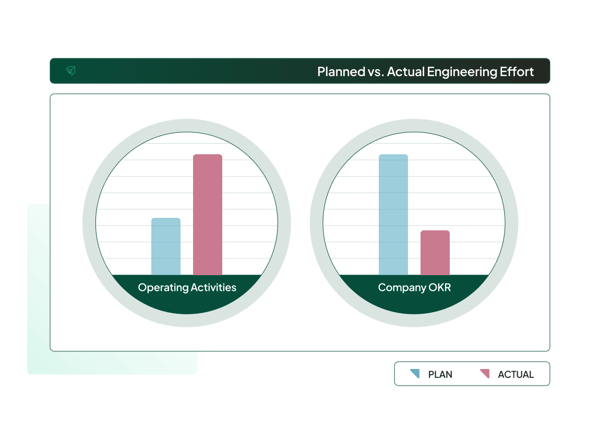
For Ankur, the goal was giving engineering leaders the ability to spot problems early, have grounded conversations with their teams, and make confident prioritization calls before options narrowed. Uplevel enabled this.
"If somebody says green but the initiatives say you're clearly off track, we can inspect deeper," says Ankur. "I now have a data view in addition to a judgment view."
Early work focused on calibration — validating that signals accurately reflected what had happened before using them to look forward. That foundation is now enabling a different kind of leadership conversation: not "why did this miss?" but "what do we do about this while we still can?"
Early use has been as much about calibration as prediction — teams reviewing historical data to validate whether Uplevel's signals reflect what actually happened. That groundwork is now enabling more forward-looking use: identifying initiatives at risk before they become problems, and reallocating resources while there's still time to act.